
As The World Cup Final Comes To New Jersey, The Fans Who Popularized the Sport Can’t Get In
With the July 19 final drawing a global audience, ticket prices reaching into the tens of thousands have shut out immigrant communities who built New Jersey’s soccer culture.
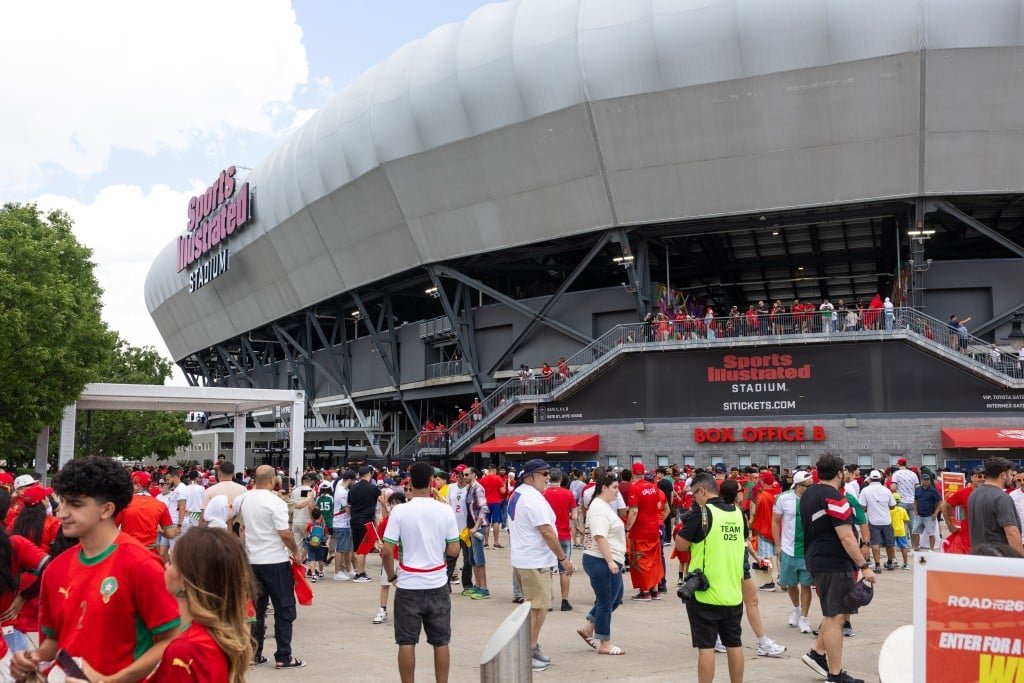
Napoleon wanted to experience the euphoric highs, the noise and drama of a match that carries far more than sporting stakes for immigrant families like his. But with post-draw ticket prices for group stage games at MetLife Stadium averaging over 41 percent higher than at San Francisco, the 33-year-old New Yorker made a different calculation.
“We were actually last week at the Paraguay-Australia [game] in San Francisco,” said the Salvadoran-American fan, who asked that his last name not be used. “We flew out to San Francisco to be able to watch a World Cup game, just because MetLife is way too expensive.”
Immigrant communities in the United States have built its soccer culture – and in the same cities and neighborhoods now hosting the World Cup. But as high ticket prices have put the tournament out of reach in New Jersey, fans are turning to watch parties – or even flying across the country — in search of cheaper alternatives.
Soccer history is New Jersey history
Long before soccer became a heavily commercialized live event or a fixture of organized youth sports, it was a working-class pastime sustained by immigrant communities in mill towns, neighborhood clubs and local leagues in New Jersey. In Kearny, Newark and Paterson, British, Scottish, Irish, Portuguese, and, later, Latin American immigrants built the soccer clubs, leagues and identity that have come to define the sport in the United States.
American soccer’s origin story can be traced back to 1869, when Rutgers and Princeton played the first intercollegiate match in U.S. history, priming the Northeast for the 1884 establishment of the American Football Association in Newark. A year later, Clark O.N.T., a team backed by the Clark Thread Company, claimed the first AFA Cup, while Kearny hosted the nation’s inaugural international soccer match.
But as colleges moved away from association football and toward rugby-style football, soccer took deeper root in immigrant communities. In North Jersey, Scottish immigrants working in the textile industry helped turn Kearny into one of the country’s foundational soccer towns. The Kearny Scots became one of the most important clubs in the sport’s early history in America, winning five straight American Soccer League titles from 1937 to 1941. Kearny would go on to produce American soccer legends John Harkes, Tony Meola and Tab Ramos.
In Newark’s Ironbound and surrounding communities, Portuguese, Brazilian, Ecuadorian and other immigrant populations made soccer part of the everyday landscape through clubs, restaurants, watch parties and the ordinary sight of national team jerseys on the street. In those spaces, soccer was not something immigrants had to learn in America, but rather something they brought with them, preserved and passed on.
‘Exorbitant’ prices
When the World Cup matchup list became available, many New Jerseyans flocked to the FIFA website to buy tickets – but they were often met with high prices. FIFA’s demand-based pricing, the premium attached to the New York-New Jersey market and volatility in resale markets have turned attendance into a major financial decision.
As of Dec. 11, 2025, FIFA’s officially listed prices ranged from $220 to $8,680, depending on tournament round and seating category. Prices have since fluctuated due to FIFA’s dynamic pricing, while resale asking prices varied wildly. AP found tickets for the final game listed at about $23,000, $33,000, $138,000, $207,000 and even $2.3 million.
Zineb Anouar, a Moroccan-American soccer fan from Philadelphia who volunteers with the New Jersey-based Moroccan American Recreational and Organizational Council, was excited to hear Morocco was scheduled to play Brazil at New York New Jersey Stadium. The matchup seemed like a rare opportunity: the Moroccan national team playing in North Jersey, near one of the largest Moroccan communities in the country.
Anouar was among those who couldn’t afford to attend. She said many Moroccan supporters gathered outside MetLife while their national team played.
“At first, it was beyond exciting to find out that the Moroccan national team would have a presence in the northern Jersey area and within proximity of a large Moroccan community,” she said. “It became heartbreaking when ticket prices increased significantly, which deprived the majority of Moroccans in the area of attending and showing their support.”
“Ticket prices are outrageous and definitely exclusive,” she said. “A large number of people, including myself, were disappointed to find out that we could not attend any of the matches due to ticket affordability.”
For New Jersey resident and soccer fan Andrea Rodriguez, the prices feel alienating, even to people living in the U.S. with relatively stable incomes. Rodriguez is from Mexico and played the sport, attending the Mexico-Ecuador watch party at the fan hub in Harrison’s Sports Illustrated Stadium.
“For us, coming from Latin America especially, the extremely high price of these tickets feels unbelievable — it’s inexplicable,” she said. “Even for us living here, already with a more stable salary, it’s impossible — well, not impossible, but I feel like it has to be your priority, maybe your top priority, and you would have had to save for a long time.”
She paused on the contradiction: not that no one can pay, but that paying requires a financial sacrifice that excludes many in the communities most emotionally invested in the game.
“Even then, it’s too expensive,” she said. “I mean, not everyone can do it. Not everyone.”
Napoleon was more direct when asked whether ticket prices exclude communities that form soccer’s core fan base in America. “Oh, 1,000 percent,” he said. “Obviously, these are ridiculous prices.”
Anouar views it as a form of gentrification, saying the exclusion is harder to accept because the U.S. is a tournament host.
“It is unfair to have fans from overseas attend while the average American citizen cannot,” she said.
A generational sport
The ticket prices particularly stung because of what soccer means to many communities across the world, sources told New Jersey Urban News.
Anouar said football binds together not only people across Morocco but also its vast diaspora, whose attachment to the game has deepened alongside the national team’s rise in recent years as Africa’s strongest team and one of the world’s top-performing national sides.
“In Morocco, football is more than a sport,” Anouar said. “It is a unifying force that brings the Moroccan people together.”
The sport crosses geographic and economic lines, she said, connecting Moroccans in different parts of the country with those who have built lives elsewhere. “Football bridges social and economic divides,” Anouar said. “It is a source of pride.”
Football is deeply tied to Rodriguez’s upbringing, too, noting that her dad instilled a “love of soccer” in her. The sport is also equally a cultural, familial and social expression for her. Married to an Ecuadorian man, she sees her own marriage as a microcosm of those dynamics, pointing to the soccer and geopolitical rivalry between Mexico and Ecuador. Still, she sees soccer as one of the few spaces where differences are embraced and tolerated rather than erased.
“I think it’s something that unites all of us,” Rodriguez said. “A sport can unite the whole world, and language doesn’t matter, culture doesn’t matter, nothing matters.”
Napoleon describes a similar familial climate. Soccer, he said, “starts at home.” His grandfather followed it, and so did his father. He tries to keep up with the sport year-round, but the World Cup is different, he said. With his roots stretching back to El Salvador, he sees the tournament as a moment when dispersed communities reorganize their schedules — and loyalties — to celebrate each other’s joy.
“Our team [El Salvador] never makes it. We’re supporting Ecuador today,” he said. “For us, it’s more about being able to … acknowledge and support every single Latin American country.”
The financial inaccessibility of the live experience has left many fans wondering who the tournament is for — especially as the World Cup comes to a region whose soccer culture was built by immigrants, at a time when some of those diasporas are increasingly becoming the target of mass deportations.
“I hope this changes in the future and access is granted to everyone regardless of economic status,” Anouar said. “We really need to mean it when we say ‘Football Unites the World.’”
Author

Related Articles
10 New Jersey High School Football Players To Watch In 2026
From dominant linemen to explosive two-way playmakers, these standout recruits are poised to make an impact this season—and at major college programs nationwide.

Cowboys Safety Alijah Clark Brings Mental Health Message Home To Camden
The Camden native’s youth was marked by loss. Now he’s using his NFL platform to make sure other young athletes don’t suffer in silence.