The High Price Of AI: Early Optimism Runs Into Current Reality
By Lucy Harper (NJ State House News Service)
The state’s big dream of turning New Jersey into the “Silicon Valley” of artificial intelligence has run smack into the reality of soaring energy costs, the unrealistic ambitions of overly optimistic lawmakers and a public backlash against the growing number of data centers.
Former Gov. Phil Murphy established the Next NJ program to provide $500 million in tax credits for the construction of data centers, along with other financial incentives and support. He said his goal was to “shape the future of generative artificial intelligence both ambitiously and responsibly” while establishing the state as the center of the burgeoning industry.
Two years on, the vision for AI in New Jersey has shifted.
New Jersey Business and Industry Association decries the recent spate of regulations and restrictions being implemented by the state that once offered only incentives.
“No other state has proposed something as sweeping as what New Jersey is considering right now,” said association spokesman Jack Ramirez. “While the state is currently debating data centers and their impacts, eliminating the entire program would affect much more than data centers. It would have consequences for New Jersey’s economic competitiveness overall.”
Across the state, the most visible physical impact of AI is data centers.
While data centers have existed in New Jersey for decades, the rise of AI has seen a very different kind of infrastructure required to support the boom.
Four years ago data centers were smaller and demanded much less energy. The data center Equinix NY4 in Secaucus opened in 2004 is an 18-megawatt data center, which is enough energy to power approximately 13,000 homes.
Newer projects consume exponentially more energy. The Coreweave data center in Kenilworth has the potential to eat up 250 megawatts. The DataOne site in Vineland is even more voracious at 350 megawatts, or enough energy capacity to power a mid-sized city.
“AI data centers require a lot of energy and resources,” Kathryn Fisher, the campaign manager at the New Jersey League of Conservation Voters, said. “Data centers are among the most energy intensive facilities being developed today.”
The new data centers focused on supporting the AI industry require so much more energy because the large language models that fuel AI require training from computer graphics processing units which run nonstop. Because they are using so much energy, they’re also producing a lot of heat which needs to be continuously cooled down. This requires water, up to 5 million gallons per day for just one data center, according to Fisher.
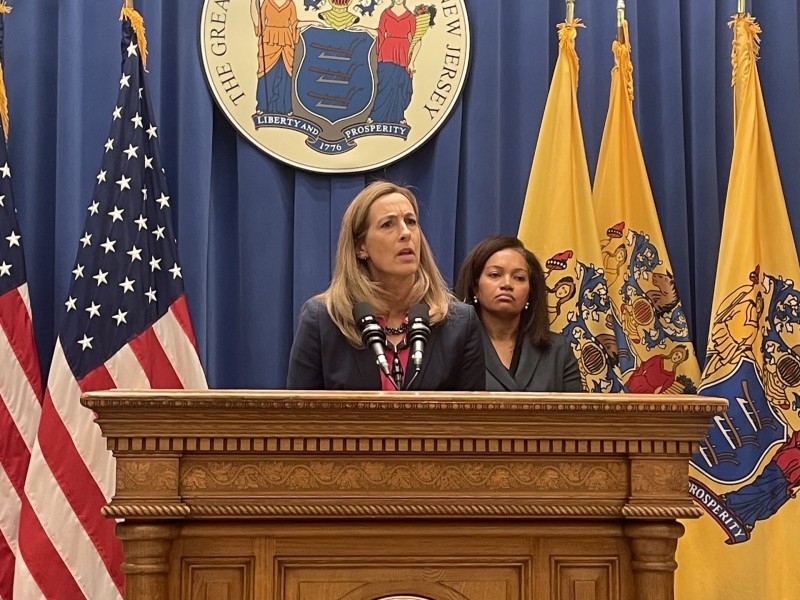
Shortly after Gov. Mikie Sherrill took office earlier this year, she committed to fulfilling the promises she made during her election campaign, immediately freezing skyrocketing utility costs and setting up regulatory guardrails for data center development.
“We’re moving forward on the data canter plan in the most innovative way in the country,” Sherriil said Monday, after she signed a measure creating a path to build new nuclear power plants in New Jersey for the first time in decades. “I think this state is really poised to be such a leader in this space.”
Environmental activists and others applauded her efforts on data centers.
“This is a step in the right direction for the state to actually understand how much water is being used in New Jersey,” Anjuli Ramos-Busot, chapter director of the New Jersey Sierra Club, said. “Particularly because we’ve been in a drought for 2 years.”
The End Data Center Tax Credits Act was passed by the legislature this spring and is on the governor’s desk. It would end Murphy’s Next Program NJ – AI Act, which dedicated $500 million in tax credits to support AI development in the state.
“New Jersey has become a regional leader in this space,” Jack Ramirez from New Jersey Business and Industry Association, who was against the legislation, said. “The bill currently being discussed would put a dent in the progress we’ve made.”
“No other state has proposed something as sweeping as what New Jersey is considering right now,” he added.
In the two years since the program has existed, however, only one project has benefited from that tax credit, the Coreweave data center in Kenilworth.
Even so, plans for the $18 billion project have pitted Union County residents against each other.
While the Kenilworth planning committee unanimously approved construction of the data center 13 months ago, recent biweekly meetings have seen residents from across the county raise concerns, not only with its environmental impact and energy usage, but crucially the mayorship’s lack of transparency behind the project and their belief in her lack of receptivity to criticism.
“I recognize that some citizens feel frustrated, and I understand why emotions can run high on an issue of this magnitude,” Mayor Linda Ludovitch told the township at a meeting in June. “But I reject the notion that providing factual information, even when it differs from someone’s beliefs, is evidence of not caring.”
For Sean Keagan Foley, former councilman in Garwood, his primary concern was the lack of information about the impact of data centers.
“For decades we’ve been told that technological progress would make our lives better, make life more efficient and create more opportunity and prosperity,” Foley said. “We handed our children technologies that we promised would help them and not cause them immeasurable harm on a scale we are only beginning to understand.”
“Maybe that’s why we all are pushing back,” he continued, “because we’ve heard this story before. […] And it’s ordinary people like us who are always clearing up the mess.”
He asked the council to consider a pause in the data centers development. “Progress is not measured by how quickly we move,” Foley said. “Progress is measured by how responsibly we act.”
Ben Dziobek, executive director of Climate Revolution Action Network NJ said, “It shows that you [the Kenilworth council] may not understand the electrical infrastructure needs of a hyperscale data center if you are blindly following and going along, right?”
Dziobel says the network has prevented the construction of six potential data centers in New Jersey alone. Locations impacted include Millville, Red Bank in Monmouth and New Brunswick.
Kenilworth has become an object lesson in the divisiveness playing out in towns across the state, which has seen dozens of new projects proposed in the last few years.
When residents called for a study of the potential impact of the data center on the environment and on energy and water usage, Ludovitch shut them down. “We can’t study it because it doesn’t exist right now.” she said, suggesting studies would be completed once the project was finished.
It’s not just the extreme energy and water use that concerns residents. They are also worried about the effect of the data centers on the value of their property in Kenilworth and surrounding towns.
“For most people, home ownership is the biggest investment they’ll make in their lives,” Toni Johnson, a resident of Union County said.
She explained her fears about the property value of Kenilworth’s homes going down because of their close proximity to the data center. Like an airport, data centers bring non-stop noise and are an eyesore to the surrounding area, decreasing the value of property.
Johnson said it’s not too late to put the brakes on the construction.
“Every single contract can be broken,” she told Ludovitch. “Your continued involvement with Coreweave is akin to wrestling a pig. They like it and you get dirty.”
Many residents argued that the mayor and the council were ignoring their calls to pause or halt the data center project, leading them to believe that local officials were acting “against” the community.
“You’re all against us!” Mary Savino, a resident of Kenilworth, said.
“We’re not against you,” Council President William Mauro responded. “We’re looking at the facts.”
Mauro said energy prices wouldn’t “spike” for residents, despite other residents claiming that energy prices had tripled for those that lived in areas near other large data centers.
“I’ve got four data centers, small ones in the north right now. My public service bill went from $275 to $785,” Donna Jackson, a council member from Newark and prominent New Jerseyan activist, claimed. With affordability a prominent concern among NJ residents right now, concerns for the impact of Coreweave’s project were prevalent among multiple speakers.
The site where the data center will be located has been vacant since Merck pharmaceuticals shut down its operations there. The property had been a source of substantial and consistent tax revenue for the township for more than 70 years.
Mauro said the tax revenues from the data center would back-fill that gap.
“You attack us (the council]),” a clearly frustrated Mauro told the public forum. “You demoralize us, you put us down, you tell us we’re corrupt, you tell us we’re on the take, it’s unbelievable.”
One of the residents, who did not provide his name, brought a handful of emails he said he requested from OPRA to read at the public hearing.
In an email sent from Mayor Ludovitch to Coreweave on May 21st, Mayor Ludovitch had referred to those opposed to the project as “agitators” and “paid protestors,” which caused much outrage from members of the public, and further deepened tensions between the officials and residents.
Ludovitch stood by the comment, saying that “I did hear that there were some people here who were getting paid.”
Ludovitch denied public suggestion that she signed a non-disclosure agreement regarding the Coreweave project and declined further comment.
Coreweave declined to comment on the Kenilworth project, which is set to be completed by 2027.
“If Kenilworth isn’t going to stop this data center from being built, it can still impose restrictions that will protect the local community,” Rebecca Davis from Cranford said at the most recent meeting on July 1st.
With an online petition of over 12,000 signatures to halt Coreweave construction completely and calls for a referendum on the issue, tensions in Kenilworth and about future proposed projects across the state will likely persist.