
New Jersey’s Housing Crisis And How The New Federal Bill Effects It
With the recent passing of the 21st Century Road to Housing Act, housing experts examine the law and question the impact it will have on the state.
A new bipartisan federal housing law could help New Jersey residents rebuild after disasters and purchase affordable housing. Experts on New Jersey’s housing crisis say the federal government’s bipartisan legislation is a “good start,” but does not solve the complex housing issues in a state plagued by decades of discriminatory housing practices.
On July 11, the 21st Century ROAD to Housing Act became federal law after receiving bipartisan support, despite President Trump refusing to sign, calling it “a big yawn.” The law’s passage without the sitting president’s approval reflects Americans’ concerns over the nation’s housing crisis.
In New Jersey—where renters face some of the nation’s highest housing costs and affordable housing shortages persist—the legislation could provide new relief for the state.
The legislation includes provisions that:
- Fast-track disaster recovery funding
- Expand affordable housing financing
- Limit institutional investor home purchases
- Incentivize communities to build affordable housing
Inside the provisions
The Reforming Disaster Recovery Act is a provision of the 21st Century ROAD to Housing Act, which fast-tracks disaster recovery funding and ensures equitable access to resources for lower-income populations. Due to New Jersey’s frequent coastal flooding, the legislation will allow communities to rebuild quickly after disasters.
According to Jag Davies, the Director of Communications at the Fair Share Housing Center, this provision can fix a recurring problem when it comes to federal disaster relief.
“Historically the disaster recovery system has been really inequitable, and favored higher-income communities over lower-income communities,” said Davies.
He added that the organization spent years advocating for the act after winning the largest federal Fair Housing Act settlement, reallocating $450 million after Hurricane Sandy to low-income communities and communities of color that hadn’t gotten their “adequate share of resources.”
“This is something we’ve been working on for a long time to make disaster recovery funding more transparent and to make sure it better protects low-income households and renters and make sure that federal recovery dollars actually reach the people who need them most,” said Davies.
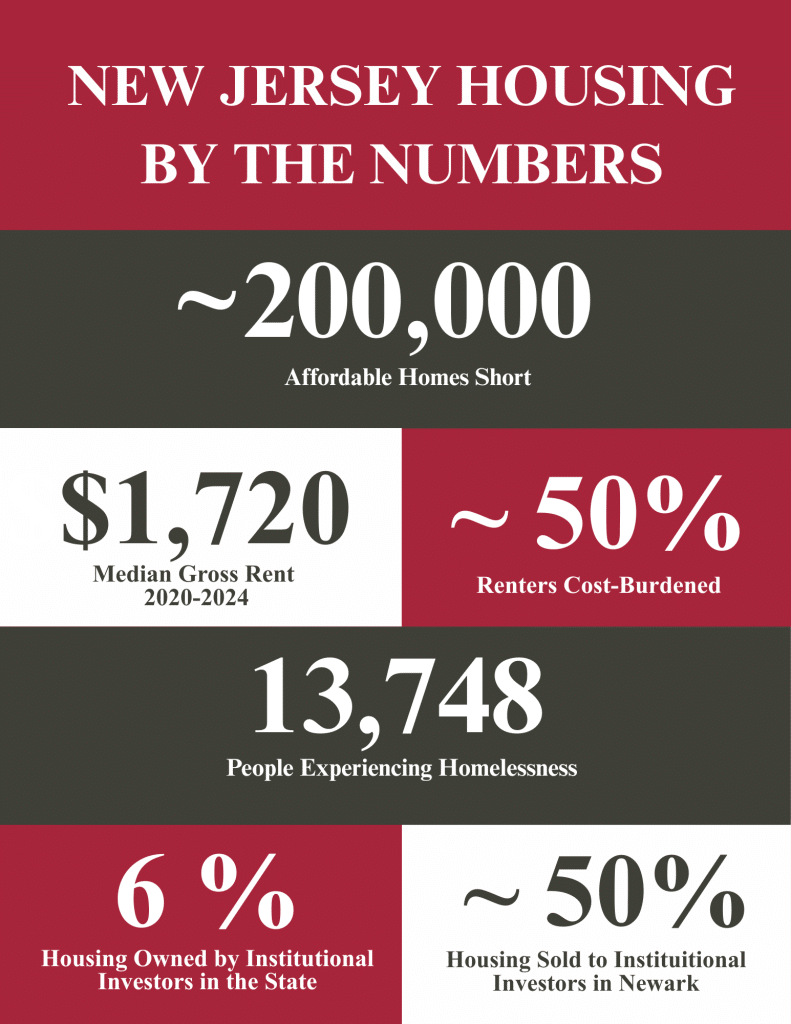
The federal law also prevents large institutional investors from purchasing more than 350 single-family homes. Although institutional investors only own roughly 2% of single-family homes nationwide, according to a 2022 Rutgers Center on Law, Inequality and Metropolitan Equity study, nearly half of Newark’s residential properties were sold to corporate buyers. This leads to fewer opportunities for first-time homebuyers.
U.S. Senator Andy Kim from New Jersey’s 3rd Congressional District led another important aspect of the legislation—the expansion of what qualifies for the Community Development Block Grant (CDBG) program—which can directly affect New Jersey residents.
“After decades of advocacy across New Jersey, towns across our state will finally be able to use their CDBG funding to rebuild after disaster,” Kim said in a recent press release. “It’s one tool of many included in this historic set of bills that will be truly life-changing for so many.”
Local municipalities can benefit from this law as the federal government will be offering rewards such as grants and other financial incentives to those that expand their housing policies. This is done through a section of the legislation called the Innovation Fund.
“The most important thing about the federal bill isn’t any single provision,” said Davies. “It’s that Congress is recognizing that the U.S. has a housing shortage and that we need a broad set of solutions.”
New Jersey’s Housing Problems
New Jersey is often described as a very progressive state when it comes to housing laws. However, the state still ranks amongst the least affordable states for renters and for monthly mortgage costs.
New homeowners like Dan C., 38, say that the current housing market is a “systematic failure,” and the government is not doing enough for young people trying to become homeowners.
“I think it’s a pretty bad thing that not a single person I know— friend, coworker, etc. —has been able to buy a house and have a kid in New Jersey without significant family support,” said Dan. “Most of the people I know have good jobs, have advanced degrees, and it’s just too expensive.”
Both Davies and Leila Amirhamzeh, Director of Community Reinvestment at New Jersey Citizen Action, say that lack of supply contributes to the crisis, but the state’s history of redlining does as well.
“Financial institutions and other entities were literally drawing red lines around communities of color, not investing in those communities in the same way that they were in more affluent or whiter communities,” said Amirhamzeh.
In 1975, a landmark decision by the New Jersey Supreme Court ruled that municipalities cannot use zoning laws to favor high-income residents by requiring every municipality to provide its fair share of affordable housing. This was called the Mount Laurel doctrine.
Since then, multiple pieces of legislation have been passed to enforce this doctrine, including the 2024 affordable housing bill signed into law by former Governor Phil Murphy. According to Davies, this law aimed to “strengthen and streamline the Mount Laurel framework”; however, while more impactful than the federal law, it too will only put a “dent” in the housing crisis.
On a broader level, much of the country’s current lack of housing can be attributed to decades of underdevelopment. The state is estimated to be short more than 200,000 homes. New Jersey’s shortage is drastic and cannot be solved instantly.
The Future of New Jersey Housing
Going forward, another piece of legislation that Amirhamzeh thinks would help relieve the housing burden of the state is a state-level version of the federal Community Reinvestment Act (CRA). The CRA encourages financial institutions to support the credit needs of all areas they do business in, including low-income areas. But according to Amirhmzeh, since the pandemic, 70% of residential mortgages are given outside of banks.
“Having a state-level CRA would actually require all financial institutions, including mortgage lenders and credit unions that are not currently covered under that law, to invest in affordable housing and community development,” said Amirhmzeh. “That would really go a long way in increasing investment for housing across the state.”
Even with the federal law and local changes, New Jersey will not fix its problem overnight.
“The vast majority of municipalities in the state are now moving forward with plans to create affordable housing,” said Davies. “There will be tens of thousands of new affordable homes created over the next few years, but New Jersey has a shortage of hundreds of thousands of homes that are affordable to extremely low-income renters.”
Author

Related Articles


Bishop William J. Barber II, Faith Leaders To Rally Against North Carolina Voting Bill
The Raleigh news conference comes as faith leaders raise concerns over voting changes ahead of the November midterm elections.

Gov. Sherrill Targets ‘Big Tech’ With New Law Aimed At Kids’ Social Media Use
The new law limits algorithmic recommendations and data use for minors on social media in a bid to combat social media harms.