
In Newark, Wildfire Smoke Piled Onto An Air Pollution Problem Decades In The Making
A week of hazardous air pushed the city’s asthma rates and pollution into view, and community advocates say Newark needs a real plan before the next smoke event arrives.
By: Sydney Salomon, Report for America
When smoke from Canada’s wildfires blanketed the Northeast in mid-July, Melissa Miles noticed something unsettling: Newark continued much as usual. Children attended summer camp, joggers ran through the haze and outdoor pools remained open, even as the air quality worsened.
Miles had spent years raising her family in Newark’s East Ward before moving to Summit in 2020 after concerns about asthma and air quality. Although she no longer lives in Newark, she still works in the city, and her children attend summer camp there.
“The thing I remember most is that almost no one was wearing an N95 mask,” Miles said. “I sent my kids to camp with masks. The camps didn’t close, and speaking to other parents, many camps didn’t even modify programming to keep kids indoors.”
The smoke wasn’t even at its worst yet: when it drifted across New Jersey beginning July 14, air quality levels were unsafe for sensitive groups; then gradually got worse, prompting state agencies to issue Code Red Air Quality Alerts and a public health advisory.
For Newark residents, the wildfire smoke only exacerbated existing environmental health challenges. Community advocates and health experts say the event exposed how ongoing pollution can leave some communities more vulnerable during climate-related disasters.
“It’s just multiplying and compounding on what is already being dealt with,” said Ajena Duckworth, urban greening program coordinator for Ironbound Community Corporation (ICC), a Newark-based environmental justice organization.
Melissa Miles, executive director of the New Jersey Environmental Justice Alliance (NJEJA), a statewide coalition advocating for environmental justice in overburdened communities, said the wildfire smoke didn’t happen in isolation. Through NJEJA, Miles works with communities across New Jersey to address the cumulative health impacts of pollution in neighborhoods already burdened by multiple environmental hazards.
Miles said New Jersey’s Environmental Justice Law recognizes the cumulative impacts of pollution on overburdened communities, but she said the law alone is not enough. She argued the state must do more to prioritize residents’ health over the interests of polluting industries.
“Air pollution layers and mixes and has synergistic and cumulative impacts on the people who live closest to sources of air pollution,” Miles said.
Miles said the state should invest in additional air quality monitors and research in Newark and other environmental justice communities to better understand residents’ daily pollution exposure and how wildfire smoke compounds existing health risks.
During the smoke event, Newark officials used their social media platforms to share updates and public health guidance. Posts on the city’s Instagram and Facebook pages shared safety recommendations, directed residents to a text hotline for assistance, identified locations offering free masks, and promoted cooling and drop-in centers for those seeking relief.
Why Newark Is Especially Vulnerable
According to data from the NJ Department of Environmental Protection, 205 Census block groups in Newark are designated as overburdened communities under NJ’s Environmental Justice Law. The designation applies to areas where there are residents who are low-income, belong to minority populations, have limited English proficiency, or meet a combination of those criteria. The law requires the state to consider how new projects could affect the health and environment of these communities before approving certain permits.
Many of those communities are already exposed to multiple sources of pollution. Newark is home to Newark Liberty International Airport, the Port Newark-Elizabeth Marine Terminal, several major highways, warehouses, manufacturing facilities and the Reworld Essex Resource Recovery Facility (formerly Covanta), NJ’s largest garbage incinerator, located in the Ironbound. Together with limited tree canopy in parts of the city, these pollution sources contribute to poor air quality year-round, increasing residents’ risk of health problems when wildfire smoke drifts into the region.
Miles said her concerns about air quality extended beyond the wildfire smoke.
“At the start of the pandemic, the home next to us became an adult rooming house where people sat outside in groups and smoked cigarettes near our bedroom windows,” she said. “At the same time, I was learning more about particulate pollution and COVID-19 mortality. All of these factors forced me out of the neighborhood at that particular moment.”
Why Wildfire Smoke Can Be Dangerous
Wildfire smoke contains PM2.5, microscopic particles that can travel deep into the lungs.
Dr. Deborah Kim, an assistant professor of medicine in the Division of Pulmonary and Critical Care Medicine at Rutgers Robert Wood Johnson Medical School, said the particles in wildfire smoke can be especially harmful.
“These particles carry chemicals that are more toxic and inflammatory than typical urban air pollution,” Kim said.
The particles can damage the lining of the airways, trigger inflammation, and weaken the lungs’ immune defenses, making it difficult for the body to fight respiratory infections, she said.
“For people with asthma or chronic obstructive pulmonary disease (COPD), this is especially dangerous because their airways are already inflamed and hyperreactive,” Kim said.
Those health risks have affected Miles’ family for years.
Her oldest son was diagnosed with asthma at the age of one, and Miles said she later developed asthma as an adult. Since moving to a suburb 20 minutes away with more tree cover and lower levels of air pollution, she said her son’s asthma attacks have become less frequent.
“None of us have acute issues aside from my oldest, and it’s become rarer since we moved,” she said. “I can only pray that he outgrows it.”
Miles said asthma has affected families throughout Newark.
“Many Newarkers know adults or older youth who have died from asthma, a preventable illness,” she said.
Those risks have been documented in NJ before. During the 2023 Canadian wildfire smoke outbreak, a Centers for Disease Control and Prevention study revealed that “asthma-associated emergency department visits were 17% higher than expected during the 19-day smoke event.”
Air Quality Worsened Across the Region
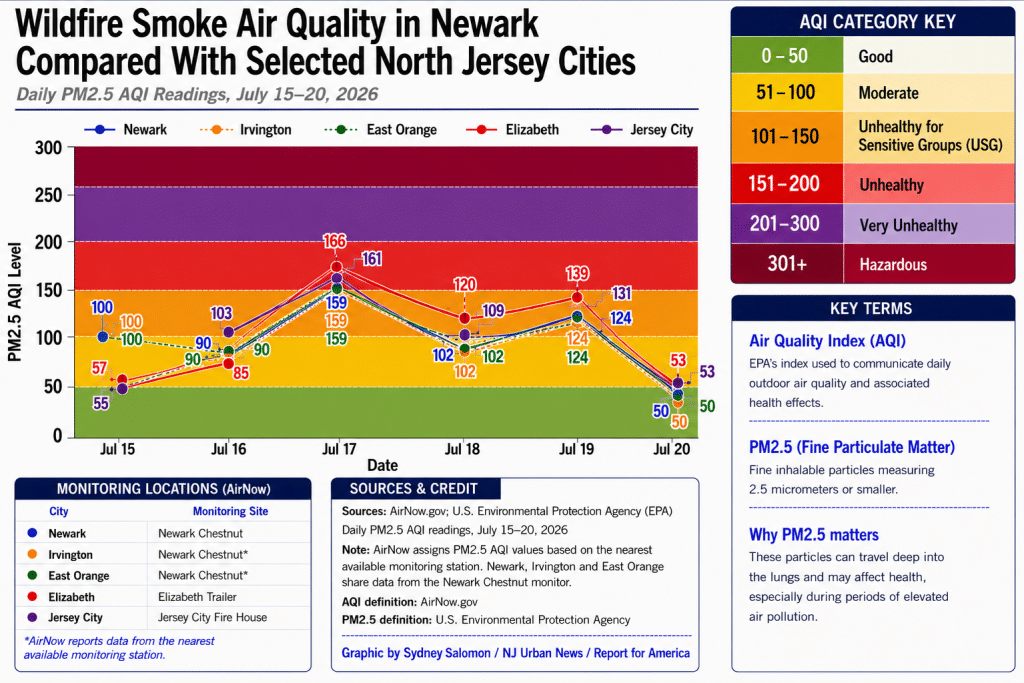
The wildfire smoke pushed air quality across Newark and neighboring communities into unhealthy ranges, illustrating how quickly conditions deteriorated as smoke settled over North Jersey.
Although the smoke eventually cleared, it was evident that for many Newark residents, the poor air quality was not an occasional crisis, but an ongoing reality.
Newark Health Burden Extends Beyond Wildfire Smoke
Newark residents are exposed to multiple sources of air pollution year-round. The city’s Ironbound neighborhood is home to NJ’s largest garbage incinerator, while Newark Liberty International Airport, the Port Newark Container Terminal, and several major highways generate additional emissions. Those pollution sources leave many residents routinely exposed, making wildfire smoke even more concerning.
According to Rutgers University, about 1 in 4 children in Newark has asthma, which is “one of the highest rates of children suffering from asthma in the state.” State health data also show that 10.3% of adults in Essex County currently have asthma, compared with 9.1% statewide, revealing that respiratory illness is also a significant concern among adults in the area.
The wildfire smoke only added to those existing health challenges.
Tree Cover Reveals Another Environmental Disparity
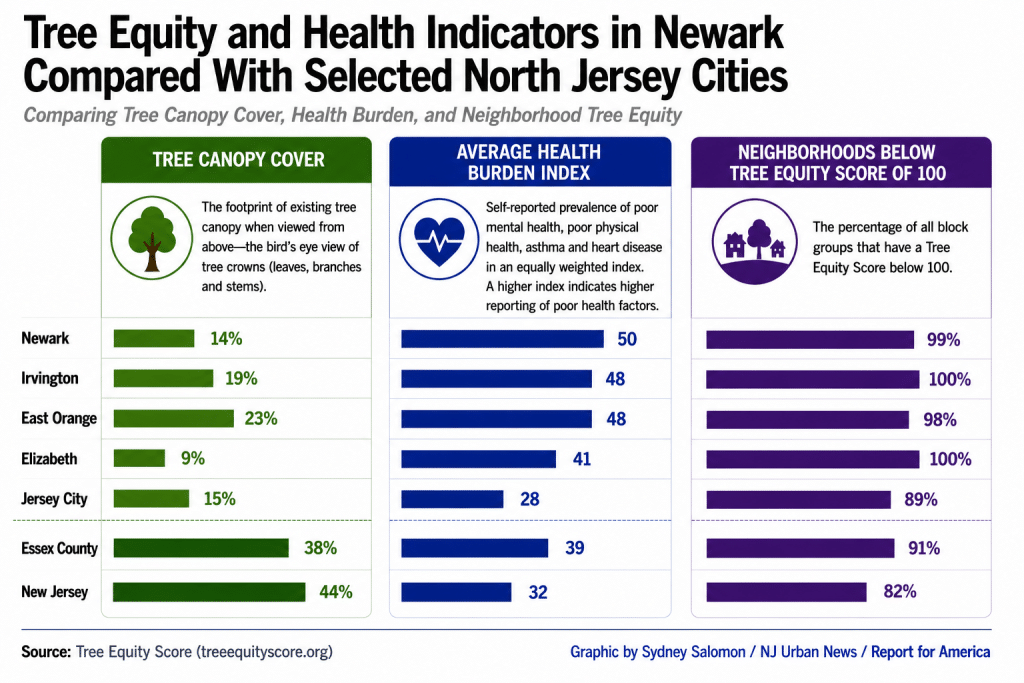
Tree equity data illustrate another environmental disparity affecting Newark. Compared with Essex County and NJ overall, Newark has significantly less tree canopy, a higher average health burden and nearly all neighborhoods fall below a Tree Equity Score of 100.
“Without the trees, we can’t have cleaner air,” Duckworth said.
According to the U.S. Environmental Protection Agency, trees help filter air pollution, cool neighborhoods and improve air quality. Communities with a low percentage of trees are limited to those benefits, which results in environmental inequities, leaving residents more vulnerable during crises.
Preparing For Future Environmental Challenges
Miles said the smoke event also showed that public health information wasn’t reaching everyone.
“I got most of my information on Instagram from regular people teaching how to protect ourselves,” she said. “Public behaviors seemed to show that folks were unaware or unconcerned.”
Miles said future smoke events should include stronger partnerships between local government and environmental organizations so residents receive timely, consistent information before and during air quality emergencies.
She said the state should work more closely with Newark and community organizations to expand air quality monitoring, provide N95 masks and air purifiers to low-income households, and improve public health preparedness during future smoke events.
Duckworth said the wildfire smoke also revealed gaps in how governments communicate with residents during air quality emergencies.
While the city used social media to communicate safety information during the smoke event, advocates said more work is needed to ensure emergency information reaches everyone, particularly residents with limited internet access or those who speak languages other than English.
“I think the biggest concern that a lot of people had was surrounding the government’s response to it,” Duckworth said. “What are we going to do so that we can be more prepared in the future?”
She said accessible air quality information is important, especially for residents with little to no reliable internet access or who speak languages other than English.
During the smoke event, ICC helped answer residents’ questions, shared air quality information, and connected community members with available resources.
“I think that the missing piece is the accessibility,” she said. “Ensuring that everybody is informed.”
Miles said the wildfire smoke should serve as a reminder that similar events are likely to become more common.
“Climate change is here.”
Miles believes preparing for future smoke events will require more than just emergency responses. It will require long-term investments in green infrastructure, expanded tree canopy and stronger protections for communities already living with disproportionate pollution burdens.
Catherine Wilson, president and CEO of United Way of Greater Newark, a nonprofit focused on community well-being, said the wildfire smoke was one of several extreme weather events that affected Newark in recent weeks, underscoring the need for stronger collaboration before future emergencies.
“As climate-related events become more prevalent (e.g. wildfires, extreme temperatures, extreme weather), it is imperative that the city, nonprofits and other stakeholders, including philanthropy and the business community, come together to build more resilience to these types of events,” Wilson said.
Wilson noted that within a month, Newark experienced extreme heat, wildfire smoke, flooding from severe rainfall, and tornado warnings. Such events she said were once uncommon in the region.
She said future preparedness includes both prevention efforts and long-term planning.
“Some of this is prevention, like planting more trees to prevent urban heat island effects and reviewing how updated infrastructure and emergency services planning can support our most vulnerable populations,” she said.
Wilson said community partnerships will remain essential as climate-related emergencies become more frequent.
“We believe the more we partner as a community to identify, plan for and address natural disasters to mitigate risks and save lives, the better we can prepare and support positive outcomes for our residents,” she said.
Author

Related Articles
Beyond the Garden Tour: Newark Growers Cultivate Food, Wellness and Community
Newark’s annual citywide garden tour opened farms and green spaces to residents for a week, while highlighting the year-round work to expand fresh food access and keep community gardens rooted in their neighborhoods.

NJ Bill Would Ban Using Green Acres Funds For Artificial Turf Fields
A New Jersey bill that would prohibit Green Acres funds from being used for artificial turf fields advanced unanimously from an Assembly committee, with environmental advocates and turf industry representatives offering opposing views.

NJ Goes Green with New Law Providing Easier Access to Solar Energy
Thanks to new legislation, New Jersey will help renters and low-income residents access cleaner, more affordable energy.