
Newark Community Market
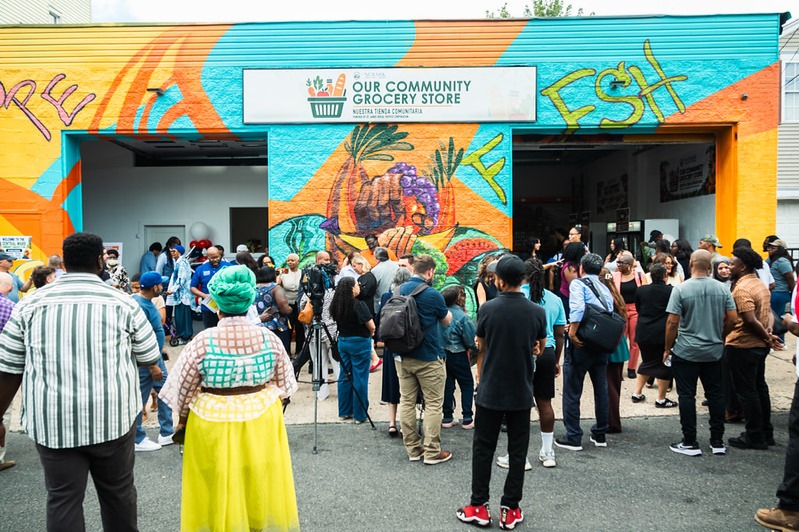
On September 10th, 2026, Newark Mayor Ras Baraka celebrated the opening of five new community grocery stores as part of a program designed to help communities that lack proper access to affordable and high quality produce and essentials.
By: Gabriel Nembhard
On September 10th, 2026, Newark Mayor Ras Baraka celebrated the opening of five new community grocery stores as part of a program designed to help communities that lack proper access to affordable and high quality produce and essentials. The initiative, according to city officials in a statement released on the day of the opening, aims to provide every Newarker with greater food access by giving every Ward in the city a retail space that can provide, like food, water, toiletries and cleaning supplies, that every Newarker needs for a discounted price.
These new community grocery stores come after a massively successful Emergency Food Hub program, launched in the winter of 2025 to support residents affected by the government shutdown, which lasted three months and left many struggling to access affordable groceries. During the shutdown, benefits programs such as SNAP faced major disruptions, with the Trump administration declining to utilize federal funds to replenish SNAP’s budget on November 1st of 2025. While a federal judge ordered the continuation of SNAP prior to its funding lapse, no new benefits were issued until after November 12th of that year, when President Trump signed an executive order restoring federal government funding, including the funding of SNAP. In that time, the City of Newark – at the direction of Mayor Ras Baraka – opened Emergency Food Hubs, stores that offered groceries at a reduced price to help alleviate the pressure on Newarkers faced with deepening SNAP cuts.
Following its success, Mayor Baraka vowed to make the initiative a permanent addition to the city’s social infrastructure, establishing one market in each ward in collaboration with established local aid groups, including:
- Central Ward: 312 New St. (St. James Social Service Corporation)
- North Ward: 39 Broadway Ave. (La Casa de Don Pedro)
- East Ward: 296 Ferry St. (Mantena Global)
- South Ward: 393 Hawthorne Ave. (Clinton Hill Community Action)
- West Ward: 503 Central Ave. (United Community Corporation)
Each of these stores were purpose-built to serve their respective communities by one of the five community action groups working with Mayor Baraka, and each of them offer a unique perspective on what their community needs, and how best they can do their part to make sure that those needs are fulfilled. One collective, the St. James Social Service Corporation, had no prior experience operating a grocery store, but instead had extensive experience in food distribution via their Emergency Food Pantry.
“While we have never operated a grocery store, we certainly know how to ‘do’ food.” Says Executive Director Vesta Godwin Clark, speaking to the press at the Ribbon Cutting on September 10th. “ Each year, we distribute more than 401 tons of food through our Emergency Food Pantry and Soul food Café soup kitchen… Having the opportunity to address food insecurity in this new and innovative way is a natural extension of the work we have been doing for more than 30 years.“
These newly opened grocery stores aim to alleviate some of the pressures Newark citizens face—high cost of living and poor food access chief among them, by providing a full range of goods for community members to purchase for 25 to 30 percent above wholesale cost, which is a 20 to 25 percent reduction in cost compared to typical wholesalers and grocery chains. Nationally, runaway inflation has increased the price of many household staples. According to a report published by NPR, the price of a pound of ground beef rose by almost 75% since 2020. Egg prices nearly doubled between 2022 and 2024. Even Coffee prices hit record highs in April of 2026. As these pressures continue to mount, special initiatives such as the Newark Food Hubs become a feasible and scalable solution to a nationwide problem intensifying in marginalized communities.
Newark’s Food Insecurity Crisis and the Push for Affordable Groceries
In a 2022 report, the NJEDA (New Jersey Economic Development Authority) ranked New Jersey’s 50 food deserts—communities with limited access to accessible and affordable grocery stores, often characterized by low incomes and primarily inhabited by BIPOC residents—by severity. Four of Newark’s five wards placed within the top ten. In total, that amounts to over 183,000 residents, more than half of the total city’s population.
According to the USDA’s Food Research Atlas, approximately 18.8 Million Americans, roughly 6% of the population, live in areas with limited or no access to either local or chain grocery stores known as food deserts.According to the USDA, food deserts are defined as a geographical area where access to nutritious, fresh, and affordable foods such as fruits, vegetables, and grains, is limited., these areas are primarily low income, regardless of rural or urban status, and are dominated by convenience stores and fast food retailers that sell filling and high calorie meals, or low quality food.
For many, reliable grocery stores may be inaccessible by walking or public transit, necessitating the use of a car, which can prove costly, especially as gasoline prices remain elevated. Since the war began, the highest recorded price per gallon of gasoline has reached a high of $5.02, with a current average of $4.17 at the time of writing, compared to last years nationwide average of $3.03. The average car holds 12 to 16 gallons of gas, meaning that on average, it can cost anywhere from $50 to $66.72 for a full tank of gas. During the first month of the Iran war, this price increase resulted in lower income households experiencing an increase in monthly spending of 12%, as well as a 17% reduction in gas consumption as people reduce trips to conserve gas. For many, this can result in fewer trips to the grocery store, or more conservative spending habits when they do make the journey.
In the vacuum left by grocery stores, chains or otherwise, fast food establishments may serve as a cheaper and more available option. Over time, this can result in poor health outcomes for those living in affected communities, further exacerbating an already mounting problem, and turning a Food Desert into a Food Swamp. Defined as areas lacking in nearby grocery stores but saturated with fast food and junk food retailers, those living in Food Swamps are often at even greater risk for high cholesterol and Obesity, as fast food, even if it is not healthy, can potentially be more cost effective for people with low incomes compared to healthier foods, which can be harder to come by, and more expensive.
Newark, in particular, has long struggled with low food security and accessibility. In many areas, such as the area surrounding West Side Park, residents have gone without grocery stores for decades, and heavy industrialization has left many areas of the city with contaminated soil, making agricultural efforts especially difficult. Attempts to alleviate these pressures have been made, to varying degrees of success. In 2013, Key Foods, a grocery retail chain which primarily operates in New York and Northern New Jersey, opened a location on Springfield and South 10th street, in a neighborhood that had not seen a grocery store in decades. In 2014, that same grocery store was shut down, after less than a year of operation, due to mounting construction costs and poor sales. The location of the now closed Key Foods has not been filled since, leaving the community with limited options that are either further from their homes, or more expensive, which is often more prohibitive than distance.
The City of Newark’s Community Grocery Store Initiative reflects a growing interest in publicly supported grocery models as cities seek new ways to address food insecurity and the rising cost of living. Among voters, cost of living is top of mind in this coming midterm election, and during the 2024 general election, the price of eggs and other foodstuffs took center stage for many Americans as a deciding factor in how they cast their ballot. Many newly elected public officials, from Mayors to Governors, have taken the opportunities afforded to them to try new avenues of reducing prices for the Americans who need it most.
Perhaps the most notable example of this lies in New York City Mayor Zohran Mamdani. During the election season, Mamdani famously campaigned on affordability, vowing to open city-run grocery stores aimed at selling goods to New York residents at a lower price. This plan, as well as promises to increase the speed and frequency of buses played a crucial role in his election, and drove massive voter turnout in the city. Since taking office, plans for opening the first of five municipal grocery stores – one in each borough – in Hunts Point, Bronx, by the end of 2027 have since been drafted and are underway.
For Newark’s own Community Grocery Stores initiative, however, work is far from over. Newark remains one of New Jersey’s most food insecure cities, and while much has been done to help alleviate the pressures created by this reality, these efforts are largely in their infancy. It remains to be seen how the city plans to scale up these endeavors, and if the city can be both reactive and proactive in pursuing its war on hunger. For now, however, the five community grocery stores stand as an example not just to other cities in New Jersey, but across the United States, providing a model for what city-run grocers can look like. All five stores will soon accept SNAP and WIC benefits, while the city’s Office of Sustainability, Resilience and Community Transformation plans to build on the program’s progress in the years to come.
Related Articles
New Jersey Urban News Welcomes Sydney Salomon as Our New Community Impact Reporter
New Jersey Urban News welcomes Sydney Salomon as its new Community Impact Reporter through Report for America, expanding coverage of issues impacting Black and Brown communities across New Jersey.

Pride Comes to South Jersey Communities With Few LGBTQ+ Spaces
Organizers say grassroots support for LGBTQ+ residents runs deep in a region that lacks concentrated community spaces
In Newark, Soccer Speaks Every Language
FIFA World Cup 2026 brings global energy to a city already fluent in culture, community and the joy of the game.