All Black National Convention Panel Explores AI’s Role In Black Business
Entrepreneurs and business leaders discussed how AI can support daily operations, reduce costs and improve efficiency without replacing human expertise.
As artificial intelligence reshapes the way businesses operate, Black entrepreneurs are weighing how to use the technology without losing the human expertise that drives their work.
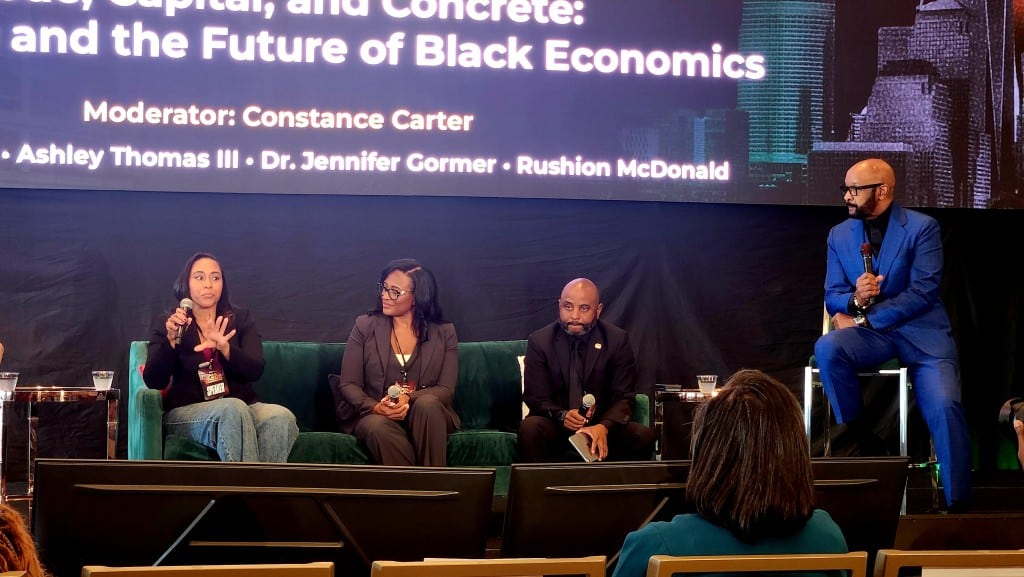
That question took center stage earlier this month at the All Black National Convention (ABNC) in Jersey City, where a panel titled “Code, Capital, and Concrete: AI Literacy and the Future of Black Economics” explored AI’s growing role in business and its implications for Black economic development.
Founded by Dr. Boyce Watkins, ABNC is an annual, multi-day event centered on Black economics, business development, families, and communities. The panel brought together business owners who discussed how the rapidly evolving technology is affecting their respective industries.
The two most resounding points? AI is a tool only as good as those who use it, and it can’t ever truly replace human beings.
“I’ve been using ChatGPT for about two years for my business for daily tasks, organization, and communication with my clients,” said Shalaye Camillo, founder of Vital Source Realty based in Boston.
“While I use it for that, AI cannot replace your expertise. Whatever it is that you do, you should not be saying ‘I want to get into this new industry and just use AI to build myself a new business.’ You need to take what it is you do, and use AI to leverage that.”
Other panelists echoed this sentiment.
“There are some things where you need a human, you need a brain, to be able to reason, assess, and make specific decisions to weigh the cost,” said Dr. Jennifer Gormer, President and CEO of Integrity Home Lending, founder of the Black Mortgage Professional Alliance, and Chairwoman of the Black Homeownership Council at the Broker Action Coalition.
“AI is not a person and it can’t do that.”
Panelists also took the time to educate the audience on a phenomenon known as AI hallucination, which can be defined as an instance where an artifical intelligence system provides information that is factually false or misleading while presenting it confidently as though it were fact.
“When you’re trying to use AI to replace a human, that’s where you need to stop,” said Gormer. “That’s the wrong way to use it.”
For the panelists, the goal is not to let AI replace human expertise, but to use it strategically to strengthen the work entrepreneurs are already doing. As the technology continues to evolve, knowing when to leverage it—and when to rely on human judgment—may be just as important as knowing how to use it.
Author

Related Articles
NRBP Brings Employers and Workforce Partners Together to Strengthen Newark’s Talent Pipeline
Eye Opener program highlights the business case for hiring locally and the need for stronger connections between employers, educators and workforce organizations