
A New Year For Jazz Students At NJPAC Music Program
Registration opens with new opportunities for TD Jazz for Teens 2026-27 year.
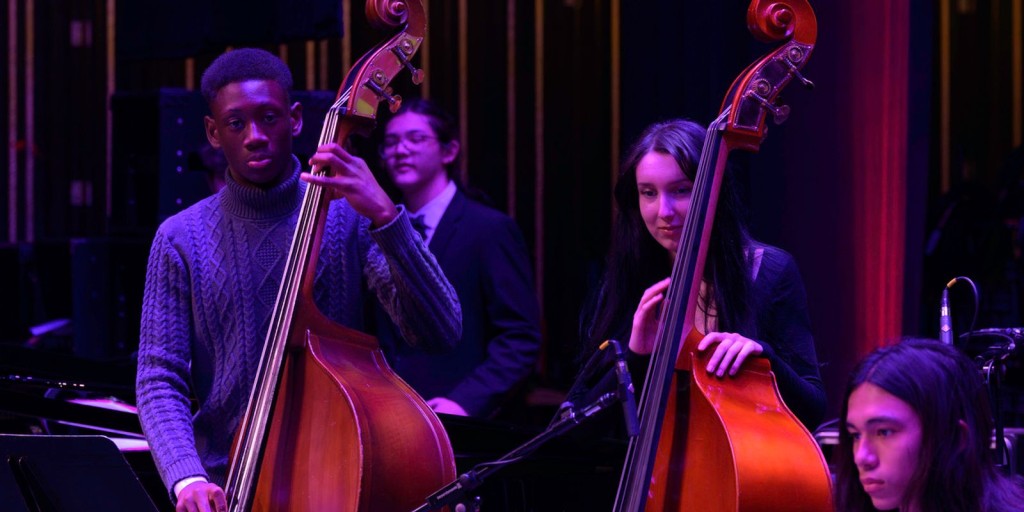
Jazz is still proving to be as popular as ever. With recent events like the Montclair and Paterson Jazz Festivals kicking off the summer, the New Jersey Performing Arts Center (NJPAC) is celebrating 29 years of teaching young musicians through its popular TD Jazz for Teens program.
The Jazz for Teens 2026-27 curriculum includes jazz history, theory and composition, instrumental technique, small and large ensembles, music business, production, and improvisation, among others. Participants also perform regularly with other talent, like the James Moody Jazz Orchestra and the George Wein Scholars Ensemble, and gain the opportunity to compose and record professionally original music in a studio.
Jazz for Teens, which will begin accepting applications in the fall, has provided jazz education and performance opportunities to thousands of high school students from Newark and the surrounding areas since the late 90s. It is one of NJPAC’s earliest arts education initiatives, and has become a training ground for emerging jazz artists, with alumni including MacArthur “Genius” Fellow Tyshawn Sorey.
The jazz education program provides students with musical instruction from professional artists and offers opportunities for artistic collaboration and guidance as they explore college and career paths in music.
“There’s a resurgence with younger folks coming up as instrumentalists who are being inspired not only from their music instructors in high school, but they’re seeing globally how people their age are equally interested in jazz,” says Mark Gross, Artistic Director of TD Jazz for Teens. “I see it when I go to places like Smalls Jazz Club, or anywhere there’s a jam session.”
During his time as the program’s saxophone teacher, Gross always enjoyed the craft and saw the value in helping students realize their potential and pour into them in a way that uniquely addresses their needs. Gross now serves as the Artistic Director of the program and has a big vision for how to get talent into the roles they deserve.
“What I wanted to do was form a pipeline into the next step. With such a long-running program and robust roster, most of [who] went on to study music or a particular lane in the performing arts, there was no real connection to the universities, colleges, and schools of music. We wanted to teach young artists what they needed to be in a better position to start looking at schools.”
Returning student bassist Lukas Womack, who has been in Jazz for Teens for the past three years, recalls how Gross has helped him with his playing and in becoming the person he wants to be.
“He’s a great teacher and role model,” says Womack. “I’m definitely more intelligent now in understanding where things go in music and, in a sense, playing it. I just have to get it out of my head and into my fingers. It’s a skill that I’m still honing.”
In his time at Jazz for Teens, Womack says he’s learned valuable skills, like the importance of listening not just to what he’s playing, but to all of the instruments in the ensemble.
“I realized that it’s important to listen to everybody around me and how to not just play the changes in the music, but to play them as the musicians are, like catching the hits on a piano or drums and echoing it my own way,” he says.
Womack had already been playing electric bass when his mother—who felt that a well- rounded musician should be immersed in all genres—enrolled him in Jazz for Teens. She says her decision to enroll him in the program allowed him to grow and develop artistically, and improve his music literacy. Her hunch was correct; He has since transitioned to the upright bass.
“It requires different muscles to play electric bass than it does upright,” he says. “I had to be more comfortable with intonation on my left hand and technique on my right. Within that first week, I had blisters all over my hand.”
In addition to being challenged to grow in his artistry, Womack says the program has taught him a certain level of rigor, something that will serve him well as he continues his music studies at Rutgers New Brunswick, where he hopes to join the jazz ensemble and minor in music or jazz studies.
Registration for Jazz for Teens closes on Saturday, October 10. You can register online at njpac.org/arts-education.
Author

Related Articles
The Power Of Public Art On Display In Camden
Artists and community organizations are using murals, galleries and public spaces to challenge the narratives imposed on Camden and affirm the beauty and humanity of its residents.

Black Theatre United Announces Fourth Annual Gala: “Work To Do” Honoring George Cheeks, Delroy Lindo And Paul Tazewell
Monday, October 5 at the Ziegfeld Ballroom. Tickets on sale now!