
Camden’s School Takeover: How State Control Stripped Democratic Power From Residents
State control of Camden schools has stripped residents of democratic power while accelerating closures and charter expansion.
State-led “reforms” in Camden are threatening the survival of public education in the city—and stripping residents of democratic control over their schools.
On October 28, New Jersey’s Commissioner of Education, Kevin Dehmer, announced the department’s undertaking to assess how resources should be allocated to city schools moving forward. The district, through the state (Camden’s school district is under state control), has retained the services of FLO Analytics, a national data analysis firm, to determine whether the money being spent in Camden is being used in the most effective way to meet the district’s needs for its 6,900 students.
Before that, state and local officials, including Gov. Murphy, Democratic party boss George Norcross, and Camden Mayor Carstarphen, announced the creation of the Camden Preschool Initiative, a pilot program that’ll assess preschool education in Camden and improve instructional practices and supports.
Leading the initiative are CCSD and the Center for Family Services (CFS), with The New Teacher Project (TNTP) conducting the actual study. Funding for the initiative is provided by the Rowan University/Rutgers-Camden Board of Governors and the Norcross Foundation, totaling $550,000.
The announcement of these endeavors carries the weight of the policymakers—during an election year—to display a commitment to the city of Camden and its youth. Yet these initiatives should be read as the latest phase of a decade-long project to strip Camden residents of democratic control over their schools. But it’s more likely that these initiatives are designed to exacerbate more of the same for CCSD.
By more of the same, I mean budget cuts, reallocating resources of all kinds to city Renaissance schools, and the closing of city schools. This has been the modus operandi since the takeover of CCSD began during the 2013-2014 school year.
Since that time, according to New Jersey Department of Education (NJDOE) data, CCSD has seen 10 schools closed, consolidated, or handed over to Charter Management Organizations (CMOs), bringing the total from 26 to 16. Since that time, CCSD reduced its overall staff from 1,329 to 857, with educators of color (teachers, administration, and professional staff) taking the greater hit—a 45% reduction—than white educators in the district—a 21% reduction. Policy decisions that yielded these realities, including the creation of the Urban Hope Act, have facilitated the student exodus from CCSD to both independent and Renaissance charters.
The argument has been made—and repeatedly so—that these changes were necessary because Camden schools were failing. The response no one wishes to address is that this doesn’t happen to predominantly white school districts. Only school districts with a majority of Black and Latino students—Jersey City (1989), Paterson (1991), Newark (1995), and Camden (2013)—have been taken over by the state of New Jersey.
Additionally, according to NJDOE data, 73 of the 88 charter schools—charters being the go-to alternative during a state takeover in New Jersey—in the state serve majority-Black and Latino students, and 45% of all charter schools are located in municipalities in the top 25 for municipal poverty rates.
Since 1989, over 100 school districts around the country have experienced a takeover, with the goal of dramatically improving the district’s academic or financial performance. School district takeovers disproportionately target districts with higher concentrations of low-income and nonwhite students, regardless of educational achievement. However, they don’t improve either academic or financial performance for the claimed districts.
According to NYU professor Domingo Morel, author of Takeover: Race, Education, and American Democracy, state interventions—including the one in Camden—often accomplish their intended purpose, serving as a political power play by the state to control the political and economic destiny of districts in traditionally Democratic cities led by Blacks and Latinos.
While justification for such a power move by the state is often cloaked in the language of rescuing children, another likely explanation for taking over Camden, Morel suggests, is retaliation for the court-ordered redistribution of public monies from suburban to urban schools.
The Abbott v. Burke court decisions mandated that wealthier suburban districts share resources with cash-starved urban schools like Camden. This move created a redistribution that may have triggered the state’s move to seize control of the district.
When Gov.-elect Mikie Sherrill takes control of the State House, she will inherit a school district whose track record can be manipulated to justify its complete shutdown. The “evidence” likely to come from these new initiatives may be all the ammunition she needs to close CCSD.
It’s a very real possibility.
Regardless of who won the election last month, the fate of public education in Camden hangs in the balance. To be clear, public education has failed Black and brown students in Camden and around the nation. The failure stems not from the educators or students, but from decades of disinvestment, segregation, and policy choices that have left districts like Camden systematically underfunded.
There’s much work to be done on behalf of Black and brown students. Sadly, much of the “work” that has already been done hasn’t moved the needle but has only provided the illusion of improvement with a misguided standard; measuring student performance in traditional public schools versus charter schools, meanwhile, citywide performance continues to lag behind the state.
Both Sherrill and Ciattarelli supported expanding charter schools. The “work” done in Camden was the result of both Democrats and Republicans. Camden was taken over through a bipartisan effort. A Sherrill win doesn’t protect CCSD. The last eight years of staff cuts, school closures, and inept leadership came under a Democratic governor. I hope that things improve, but I won’t hold my breath.
Maybe that explains why Sherrill is quiet on the “work” ahead for CCSD. It’s not that CCSD is without challenges and flaws. But taxpayers are entitled to control the politics, economics, and academics of the school district where their children attend school… including majority Black and brown municipalities.
Camden will likely continue to fight for control of its schools. Camden residents remain without control of its schools, control of who polices them, and ultimately how they’re governed. New programs created under the guise of helping may actually hurt CCSD’s chances of survival. The construction of new buildings for students is a good thing, like the construction of the New Camden High School and the upcoming Eastside High School. But such new construction is ripe for being plucked from the district and handed to a charter school under the Urban Hope Act.
Paternalistic and neo-colonialist politics won’t “save” Camden’s schools or its people. Maybe “saving” isn’t what Camden needs at all… just a fair chance to fend for itself.
Related Articles
A City Surveilled
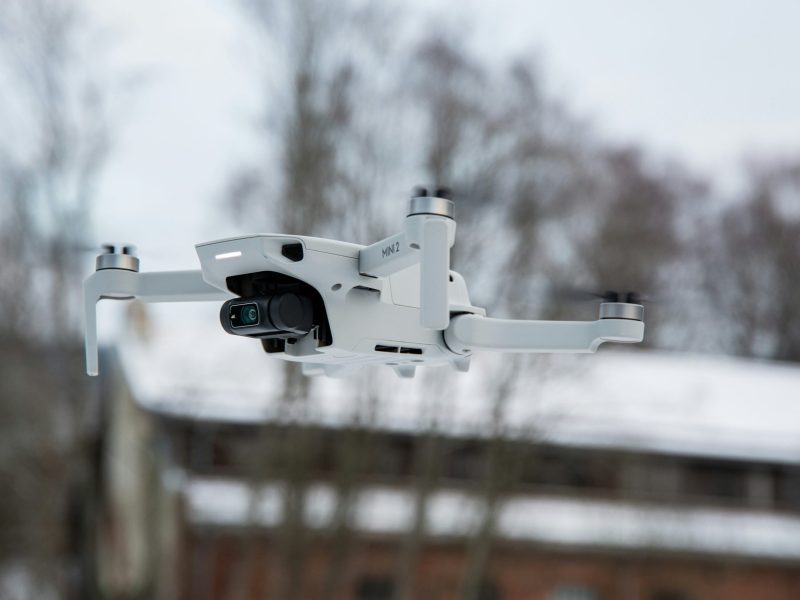
Camden operates the largest drone program in South Jersey with little regulation. But whose safety does it really serve?

NJ Isn’t Turning Red: It Already Is
New Jersey looks blue, but its politics run red. This Camden Front and Center column explains why and how.

Neo-Colonialism In Camden City Politics
Camden’s economic summit highlighted business and political power, but residents say their voices and concerns were left out.