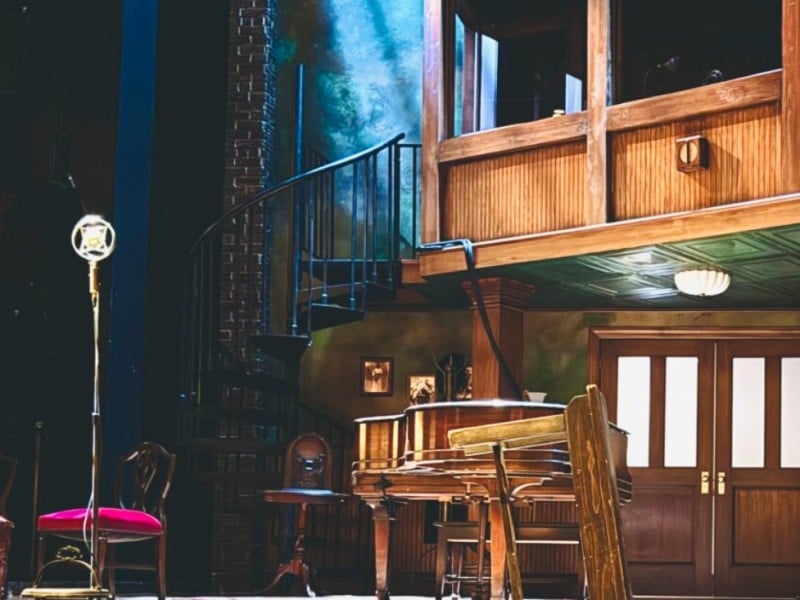
Talia Young Is Reimagining Newark Symphony Hall as a Hub for Black Creativity
With Africa on Stage, the arts leader is blending African diaspora storytelling, community programming and historic preservation to expand access to the arts and strengthen Newark’s creative economy.

At the helm of Newark Symphony Hall, President and CEO Talia L. Young is redefining New Jersey’s premier Black-led arts institution.
Blending sharp expertise in public policy and economic equity with a bold creative vision, Young leads both high-impact, diaspora-centered programming and a multi-million-dollar restoration of the historic 1920s landmark. Her mission: transform the iconic venue into an accessible engine for cultural preservation, local artist empowerment, and community growth.
NJ Urban News spoke with Young about launching Africa on Stage—a month-long festival kicked off on Oct. 3—her passion for preserving the arts, and why she’s transforming Newark Symphony Hall into the future hub of Black creativity and expression.
NJ Urban News: When did you first fall in love with the arts?
Young: Wow. It was in Englewood, where I was taking dance classes at a studio owned by this white woman. And I would say when I was in the seventh grade, and I knew I wanted to own my own dance school. I wanted to do something a little bit different. I wanted to give a little bit more creativity and space. To be 100% honest, I forgot about it. Forgot about the dream. I was more challenged by the things I couldn’t do or wasn’t in the environment for, and I tried to push myself into environments like politics and finance. Right, I had no business over there, but I learned, and it gave me the foundation of what I’m doing right now.
NJ Urban News: What was the journey that led you to the Newark Symphony Hall?
Young: I came from a finance background as a leader at New Jersey’s first African American-owned and operated bank, right? And worked on rebranding and the sustainability of getting them out during the Dodd-Frank era. Then worked for United States Senator Frank Lautenberg and the state legislators in Bergen County District. So I had a policy and legislative background and an understanding of movement, and real power comes through legislation and lobbying. Then my background is in dance. I’m a classically trained dancer. I did my thesis on African studies and impact in Harlem. So all of that, and working in the arts and advocating. I also had my own business for a few years doing high-end event design. So to be honest with you, I came to this position as a bowl of soup.
NJ Urban News: Tell us about your vision for Africa On Stage. How did it come to be?
Africa On Stage is a new initiative that the team is really passionate about. I communicate where the transition of Newark and North Jersey is really going. We have reactivated this101-year-old building, and the institution it has been famously known for for many generations, and it’s exciting because this generation of young Black creatives are leading the charge. They understand the impact and the priority of communicating the power of the African Diaspora, the creative community, the creative economy, and how different cultures really blend in the Newark community. So we launched all of this programming where a few local community organizations that focus on the diaspora worked with us, and they added to this conversation by bringing the Fela production, which I originally saw on Broadway, but found out that they were a traveling concert. So we made it happen, and now we had this robust month of programming that really touches on every kind of point of creativity.
Fela!, as you know, is talented artists, dancers, musicians, and actors, and these same musicians and actors who performed are also doing community impact. We held a community day where those same actors, dancers, and musicians are going to be teaching free classes in Newark, with vendors, food showcases, and a documentary and film. So really, just opening the doors for free for everyone who wants to experience the culture.
NJ Urban News: Fela Kuti’s work famously used music as a vehicle for political resistance and social commentary. How would you describe his work to someone unaware of his immense contributions?
Young: I would say it is a robust experience of nonstop culture. Now, one of the things that Fela did—and a lot of people say this is what prohibited him from fully coming into the commercial world—is that his artistry was built around 20- to 34-minute set songs, right? And it was the consistency of that music that set the motion and told the story. His ability to tell the story communicated what was going on culturally.
So for people who were introduced to Fela’s work for the first time had their minds blown to experience that kind of musical structure. Secondly, he addresses social situations that make people uncomfortable—things people think about, but don’t want to say out loud. And he does that. You know, we’ve seen the emergence of Afrobeats over the last six to eight years, but a lot of times people don’t know that the foundation of Afrobeat is jazz. I think it’s going to be eye-opening. I think it’s going to be a little bit uncomfortable, and I think people are going to have to question how they approach what’s going on right now in their own worlds.
NJ Urban News: What does success look like for you at Newark Symphony Hall?
Young: We’re looking for people to know and invest in Newark Symphony Hall because it’s going to have economic power. We employ young Black people and businesses- our subcontractors are local businesses of color. We also employ people of color and also invest in them. Then we can provide accessible and affordable art space that can be used for churches and plays. This week, the Alphas are having their chapter centennial gala in our building. We’ve had Hispanic Heritage Month, and we honored four different leaders in the Hispanic community. We had a Jewish play for Yom Kippur, the holiday. So think about the fact that we can provide diverse conversations on platforms that have no limitations. We’re investing in our story and our narrative.
As the month-long Africa on Stage festival brings together live music, film, fashion, food, and interactive workshops celebrating the African diaspora, Young is inviting the public to experience Newark Symphony Hall not just as a historic landmark, but as a vibrant cultural home where art sparks connection and community.
Related Articles
The Power Of Public Art On Display In Camden
Artists and community organizations are using murals, galleries and public spaces to challenge the narratives imposed on Camden and affirm the beauty and humanity of its residents.