Book Review: Tiki Davis Turns Hardship Into A Story Of Resilience
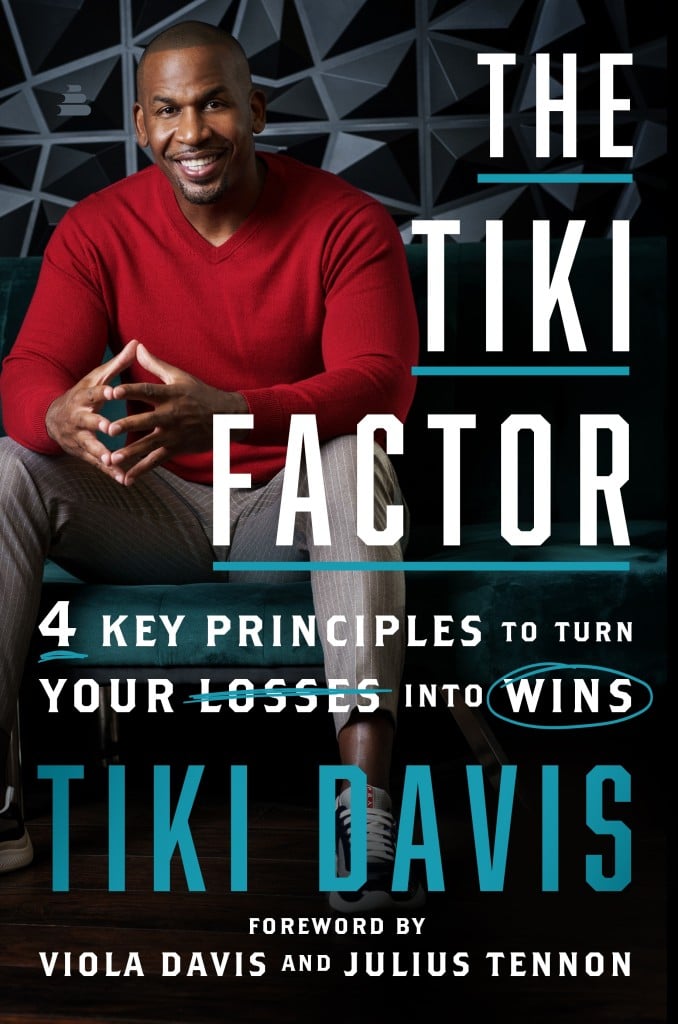
“The Tiki Factor: 4 Key principles to Turn Your Losses into Wins” by Tiki Davis, foreword by Viola Davis and Julius Tennon
c.2026, Amistad $28.99 320 pages
Pull yourself up by the bootstraps.
That’s often the advice given to someone who’s down and out and left with nothing. Get ahold of yourself, find your spine, and just do it. Take that first step, be brave, don’t accept “no” for an answer. There’s all kinds of advice for getting ahead but advice ignores one important thing: as in the new book “The Tiki Factor” by Tiki Davis, you can’t pull yourself up by the bootstraps unless you have boots first.
His life, he says, was never anything “normal.”
Neither of Tiki Davis’s parents completed high school; he wasn’t even sure who his father was until he was older. For much of Davis’s early childhood, he was shuttled between Artesia, New Mexico and Odessa, Texas, between his mother and his grandmothers. He was almost killed by his mother’s customer at age nine; he wore his older brother’s raggedy hand-me-downs until he was eleven years old. That was when Davis landed a job so he could pay for his own food and clothing. Even then, he resorted to theft when he needed something he couldn’t buy.
Adults pushed him toward sports to channel his aggression and energy, and football became Davis’s passion. He set his sights on playing for a specific local high school team, but doing so meant leaving The Flats behind and entering a boys’ home, where he found safety in what was left of his childhood. He became a leader, and he dared to dream of college.
But his track to success fell apart when he was accused, arrested, and imprisoned for a crime he could prove he didn’t commit. He missed his high school graduation, and job prospects were bleak but he was good at spotting opportunity.
Still, “It seemed every time I took two steps forward,” he says, “I was knocked back five or ten.”
At the risk of being a spoiler, “The Tiki Factor” is not without an happy ending. You’ll find goodness in this story, actually pretty quickly. What you won’t find – at least not overtly – are the promised “4 Key Principles.”
Those are inside this book somewhere, subtly, probably. Maybe. The good news is, you won’t mind if you miss them while you’re enjoying this biography, because author Tiki Davis is brutally honest about his early life. And yet, despite every slight and disadvantage, through every denial and hardship, and because of mentors and angels that came when he needed them most, he succeeded, which is a riveting tale. Davis is a businessman now, an entrepreneur, and a philanthropist and, after chapters and chapters of heart-in-your-throat reading, just knowing that might come as a whoosh of relief to most readers.
Perhaps that’s where the “Principles” are: in the overall book, hidden in tales of poverty, crime, abandonment, perseverance, inspiration, and leadership. Readers will want to possess a willingness to wait, though, to read between the lines, or at least not fret so much about these cloaked “Principles.” Do that, find “The Tiki Factor,” and strap in.
Related Articles


Dodge Poetry Festival Returns To Newark, Celebrating the City’s Growing Literary Legacy
The nation’s largest poetry festival returns to NJPAC Oct. 15–17, bringing more than 100 poets, free community events, workshops and performances to Newark as the city welcomes its first poet laureate, Mia X.