Long Justice: Pennsylvania Man’s Fight For Exoneration Continues After Spending 37 Years In NJ Prison
More than seven years after his release from prison, Ronald E. Long still seeks an exoneration he says is the only way to clear his name – a challenge shared by many formerly incarcerated people in New Jersey.

Ronald E. Long spent 37 years in a New Jersey prison for a murder he insists he did not commit. More than seven years after his release, the Pennsylvania paralegal is still fighting for something freedom alone did not give him: an official declaration of innocence.
The New Jersey government has taken steps to reverse wrongful convictions. In 2019, former Gov. Phil Murphy’s administration created the New Jersey Conviction Review Unit (CRU). Based in the state Attorney General’s Office, the CRU reviews claims of innocence by individuals convicted of felonies in state courts to determine if there is evidence of innocence.
According to Dan Prochilo, a representative of Attorney General Jennifer Davenport, the CRU has received 673 eligible applications, and 498 of them have been reviewed and closed. But as of May 10, 2024, the CRU has announced that it had overturned two wrongful murder convictions.
Long is pushing for an exoneration for a series of armed robberies in Atlantic City he says he never committed. Without it, he would continue to be recognized by the law as a convicted murderer.
“I was wrongly convicted, innocent, and condemned to death row, never to be heard from again. And I’m still fighting to this day. I’m still fighting for what I’m trying to reach,” said Long.
Arrested and Tried in New Jersey
Long was accused of committing three armed robbery shootings throughout Atlantic City in December 1982. Though the robber’s gun was never recovered, the police analyzed the bullets left at the crime scenes, determining the weapon was a .25 caliber handgun. The police then learned that Long possessed the same kind of weapon used by the robber.
Long said he was in Atlantic City visiting friends and family around the time of the shootings. However, he said that, by the time he learned he was charged with these crimes, he had forgotten exactly where he was when the robberies occurred weeks earlier. He chose not to present an alibi, fearing it would be used against him if it was wrong.
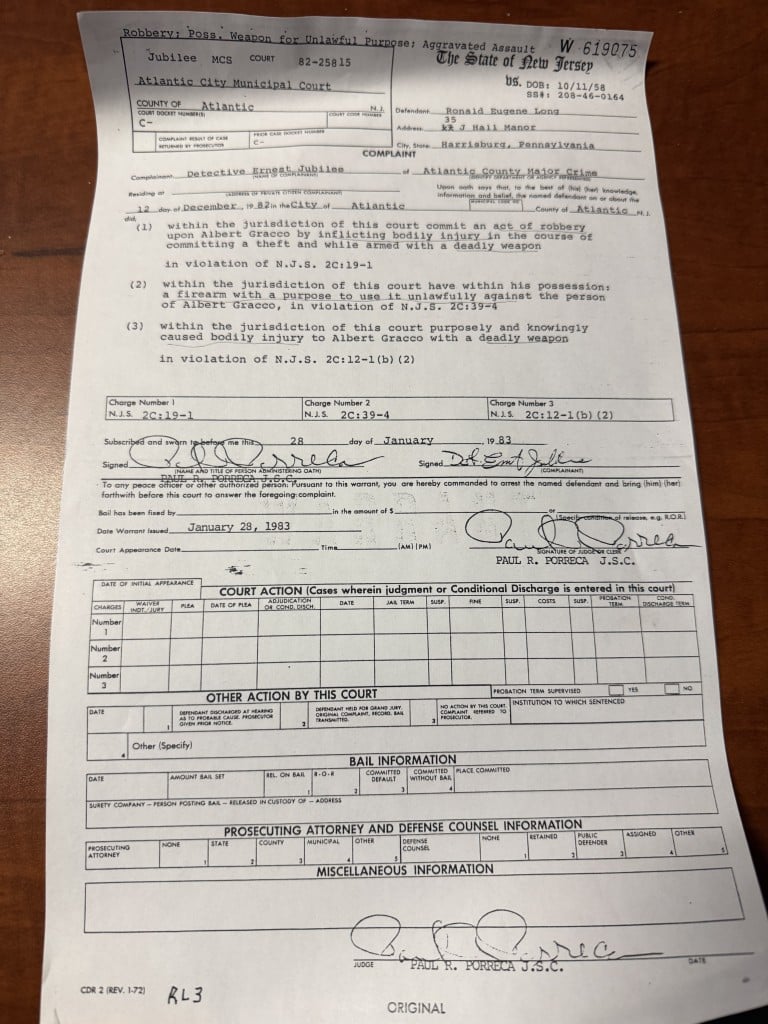
According to court transcripts, Long stated in the trial that he was at a casino or one of three separate locations at the time of one of the shootings.
Long’s mother, Louise, a retired Philadelphia deputy sheriff, said in an interview that she convinced her son to turn himself in to the authorities on January 7, 1983, to ensure the police wouldn’t get violent with him. He was put in three separate police lineups, but nobody identified him as the robber.
Long insisted there was “not one shred of evidence against [him] in the entire case.” His mother also said that “he was locked up for no reason for no good reason at all.”
Nevertheless, Long was convicted on 13 counts, including capital murder and armed robbery, and sentenced to death row. His sentence was later commuted to 61.5 years, with him being eligible for parole after 30 years and nine months.
Long eventually received lifetime parole and left prison on January 31, 2019. However, since the state did not declare him innocent, Long still requires an official exoneration.
Challenging the Evidence
Throughout his decades-long incarceration, Long maintained his innocence. He continues to demand that the state reexamine the evidence used to convict him.
This evidence includes testimony from jailhouse informant Paul Pettigrew, who later admitted to the private investigator hired by Long, Maria Palumbo, that he had fabricated. He said he did this with Atlantic City assistant prosecutor Steven Rosenfeld and Detective Ernest Jubilee to try and get a reduced jail sentence. Neither Rosenfeld nor Jubilee responded to a request for comment.
Long also challenged the prosecution’s use of a Newport cigarette butt found at one of the crime scenes. Using Long’s Atlantic County jail receipts for Newports, the prosecution argued that Long left the cigarette butt at the gas station and that he committed all the armed robberies.
The lab report shows that one technician never examined the cigarette butt. Only one other lab technician examined it, and they said that “no blood group substances were detected on the cigarette butt.”
Since 1997, Long has sought to have the cigarette butt tested for DNA evidence with newly developed technology, believing it would prove his innocence.
However, in a 2009 opinion, the New Jersey Superior Court Appellate Division denied DNA testing of the cigarette butt, reasoning that it “could easily have been left by anyone” and would not have been likely to change the outcome of the case.
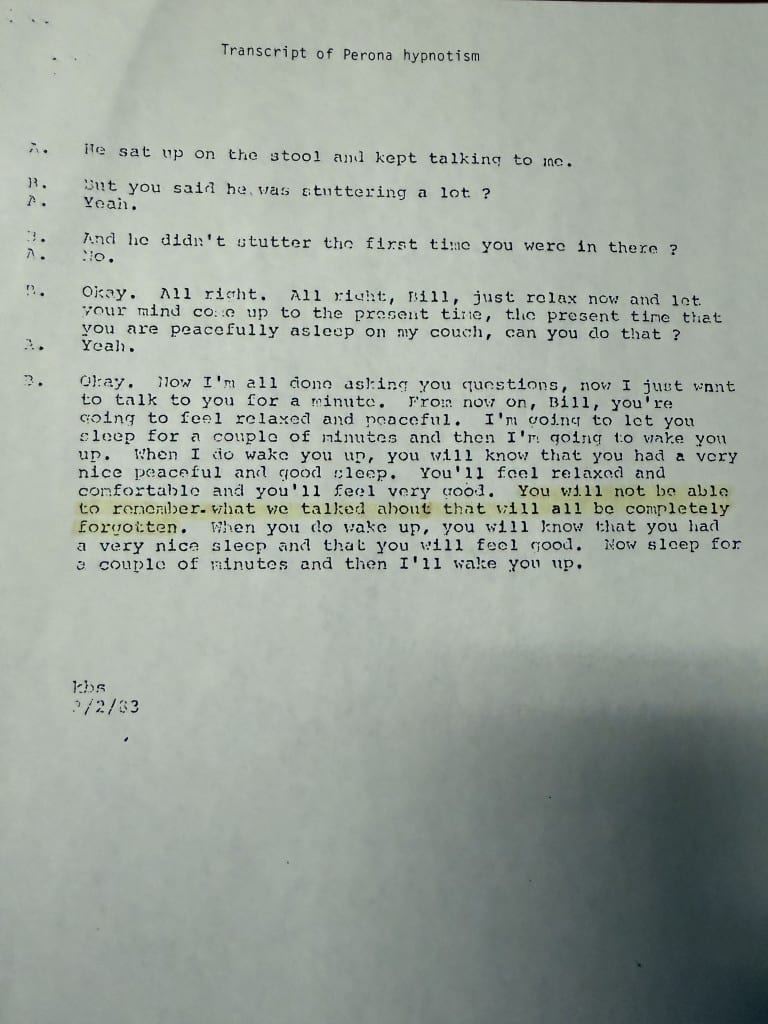
Long also questioned the police’s use of forensic hypnosis on witness William Perona before the trial. Court records show that a hypnotized Perona changed his physical description of the shooter and the time he was at the liquor store before police ordered him to forget everything he remembered from the shooting. For this reason, Long accused authorities of tampering with Perona as a witness.
When speaking to New Jersey Urban News, Justin Bonus, Esq., the New York defense attorney who represented Vincent Simmons, described the use of forensic hypnosis in Long’s case as a “red flag.”
However, Bonus said that in wrongful conviction cases, people have to deal with the “presumption of regularity,” a doctrine that assumes public officers did their jobs correctly. He also stated that conviction review units don’t want to vacate a conviction unless they have evidence the jury didn’t hear during the trial.
“It shouldn’t be rocket science, but they definitely treat it like it is. To exonerate somebody, they treat him like it’s this massive thing, and the only thing that I can think of is the fact that you have this presumption of regularity,” he added.
Going Through the CRU
Following his release from prison in 2019, Long met former state Gov. Jim McGreevey through a one-week program through the latter’s New Jersey Reentry Corporation. Describing Long in an interview as “a dear friend,” McGreevey agreed to help him after he discussed his case.
While Long had already submitted an application to the CRU, McGreevey arranged for him to have a hearing with the unit’s director, Carolyn Murray, in September 2019, to help him get his conviction overturned.

Even with McGreevey’s aid, Long did not receive an exoneration from the CRU, which required him to withdraw his motion in the Superior Court to get the DNA evidence tested so it could review his case. According to Long, the CRU said he couldn’t be exonerated because the DNA evidence was lost and that DNA testing wouldn’t have proved him innocent.
Trenton attorney Robin Kay Lord, who represented Long pro bono in his motion for DNA evidence testing, said she thinks his chances of receiving an exoneration are unlikely. She explained that the state, if it chose to exonerate him, would have to acknowledge any misconduct that occurred during the original prosecution.
“You realize what they would have to admit if, in fact, this was true? They would have to admit, systemically, that the Atlantic County prosecutor’s office engaged in a pattern and practice of fabricating evidence and threatening witnesses and lying about things. It’s beyond Ronnie…,” Lord said in an interview.
The Atlantic County Prosecutor’s Office declined to comment.
A History of Wrongful Convictions
Long’s case highlights wider concerns about wrongful convictions in the U.S., which have disproportionately affected Black people such as him. In a 2022 report, the National Registry of Exonerations found Black people made up 53% of the 3,200 recorded exonerations in the U.S. since 1989. White people accounted for 32% of these cases.
The Registry also found that misconduct by government officials took place in 72% of murder prosecutions that led to exoneration. 35% of these cases featured witness tampering, while 20% featured perjury. However, the rate of official misconduct was higher in murder exonerations featuring Black defendants, which was 78%, than the 64% with white defendants.
Years after the initial verdict, former New Jersey Supreme Court Justice Alan B. Handler said he believed that Long’s case “inescapably presents the issue of race discrimination in capital-murder prosecutions, and the Court should confront that issue directly.”
What’s Next?
Long is now among over 600 people who have applied for review to the CRU since its formation. Despite being denied an exoneration, Long continues to push for the state to overturn his conviction. Asserting that he has “nothing to hide and nothing to lie” about, Long hopes that the state government will review his case and declare his innocence.
“I just been like a hellraiser, you know, good troublemaker,” said Long. “And, at this point in my life, you know, I’m getting old. So whatever I’m doing now, it’s really not about me. It’s about the people who have been left behind.
Author