Newark Gave 16-and 17-year-olds The Right To Vote Two Years Ago. They Are Still Learning Their Power.
This story was originally published by Chalkbeat. Sign up for their newsletters at ckbe.at/newsletters.
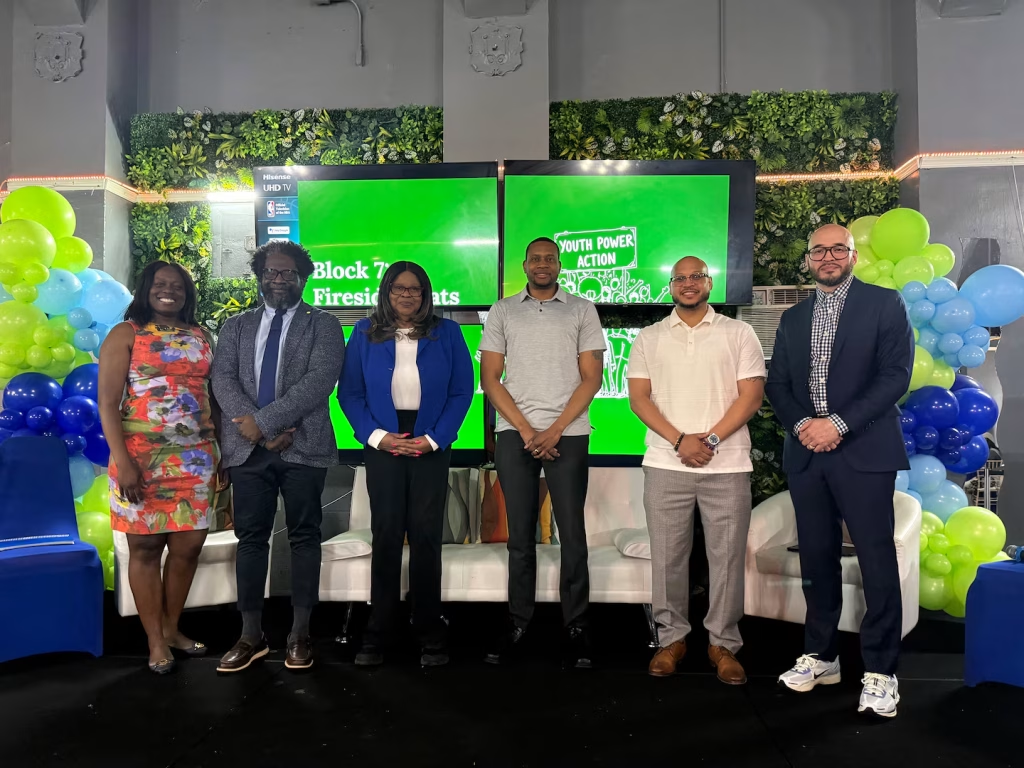
Jessie Gómez, Chalkbeat Newark
Sign up for Chalkbeat Newark’s free newsletter to get the latest news about the city’s public school system delivered to your inbox.
Judah Ancion, a 16-year-old junior at Essex County’s Donald M. Payne School of Technology, found out he could vote in Newark’s school board election from a teacher’s offhand comment last month — only a few weeks before the April 21 election.
Over the weekend, Denisha Kotey, a 19-year-old freshman at the New Jersey Institute of Technology, just learned that there’s even a school board election happening in her city.
Their realizations come two years after Newark’s 16- and 17-year-olds got the right to vote in school board elections, becoming the first city in the state to do so. That historic move prompted former Gov. Phil Murphy, Newark Mayor Ras Baraka, an award-winning rapper, and other elected officials to rally students at the city’s School of Data Science and Information Technology to pitch youth voting as a model for the rest of the state.
But even with the push, only 73 teens voted in their first school board election last April, in a city where nearly 7,300 teens are eligible to vote and overall turnout already hovers around 3% to 4% every year.
This year, that momentum has faded even more, overshadowed by the city’s May municipal race and Newark school funding debates. But for the second year in a row, student organizers and other advocates are pushing to turn new voting rights into real participation and prove that student votes can shape decisions in Newark schools.
Assatta Mann, community organizing manager for the New Jersey Institute of Social Justice, said building the youth vote in Newark will take time. She called it “a muscle that needs to grow” while pointing to the barriers keeping students from the polls, including limited access to voting sites and a lack of understanding about the school board’s role.
“Many of the young people who are registered and who do know about the election want to take advantage of this right to vote. But their polling locations are not at their schools, where they’re spending a lot of their time at,” Mann said. “There’s also no in-person early voting, for example, so it’s not even like, young people could then go and use the weekend to vote.”
Both Ancion and Kotey said they only began to understand the role of the Newark Board of Education at Saturday’s Youth Power Action Summit, which brought together more than 50 students for a day-long event organized by a student coalition to boost awareness of teen voting rights and civic participation. The group convened by The Gem Project, a nonprofit organization focused on strengthening youth civic engagement, has spent months alongside teens canvassing, hosting virtual civic education workshops, holding voter registration competitions, and informing 16- and 17-year-olds about their right to vote.
They are one of the few groups working to get students to the polls for the April school board election.
“Oh my gosh, there’s so many things going on. [The city] is finally letting students vote for stuff, they’re the majority, and they’re finally letting this happen,” Kotey said. “But people are not as involved as they should be.”
For students like Ancion and Kotey, that gap is playing out in real time. Newark’s nine-member school board makes decisions that affect more than 41,000 students on issues from curriculums to funding priorities. Teens with the Youth Power Action Coalition have urged board members to work with them and have proposed increasing student oversight over policies around mental health and school facilities. But their proposals were rejected by the city school board.
While Newark expanded voting rights to give teens a voice in those decisions, low turnout has so far limited how much weight that voice carries.
Kanyinsola Oreoluwa Owolabi, a 16-year-old junior at Science Park High School, said she attended Saturday’s Youth Power Action Summit to encourage her peers to vote, even though she can’t vote herself because of her citizenship status.
“Even if you believe that it won’t be impactful, for me, it’s more like getting a view of whom you’re letting run your society,” Oreoluwa Owolabi said.
That message resonated with Collins Esubonteng, also a 16-year-old junior at Science Park High School. He said the summit made him feel included in civic discussion around the upcoming school board race, and it was something he had never experienced in school before.
“It was a lot of fun, but for the most part, it was very informative. We’re all learning. We all learned about the system,” Esubonteng said, “I feel like there was just a lot for us here today. We’re going to see a lot of people voting.”
The Youth Coalition is also working to give young people ages 16-24 free rides to polling places. The challenge remains in reaching those young voters.
Ancion, the junior at Essex County’s Payne Tech, wasn’t able to register to vote in time before the March 31 deadline. But after leaving the summit on Saturday, he feels inspired to lead his own voting initiative next year and bring change.
“So it’s just understanding how it all works and just gaining that basic expertise so I can apply everything I learned outside of here,” Ancion said.
Jessie Gómez is a reporter for Chalkbeat Newark, covering public education in the city. Contact Jessie at jgomez@chalkbeat.org.
Chalkbeat is a nonprofit news site covering educational change in public schools.