
What it Means That Jalen Hurts Came to Camden
Hurts is proving that books can build what bricks and stones can’t.
I’ve lived in New Jersey all my life, and yet I remain fascinated by the state’s cultural construction.
North Jersey is influenced by New York City. South Jersey is influenced by Philadelphia. There’s no better explanation of how that works than in sports team fandom. North Jersey football fans, for example, root for the Giants and the Jets. South Jersey football fans root for the Eagles.
Central Jersey isn’t influenced by anyone because…there is no Central Jersey. Only North and South, but I digress.
Growing up in South Jersey, my favorite player was Randall Cunningham, who was the Eagles quarterback for 10 years. He was the face of the team and the face of Black quarterbacks. Shout out to Warren Moon and Doug Williams, Black QBs who were great players, but Randall was the guy because of his combination of attributes: arm strength, athleticism, and speed. He was labeled the ultimate weapon. He was a star. He even had his own television show on Saturday nights—as most QBs had. To quote Terrell Owens, that’s my quarterback.
But what endeared him to me more than anything was his love for Camden’s people.
Cunningham attended St. John’s Baptist Church in East Camden under the direction of Dr. Silas Townsend. In 1992, he funded a community center built by the church for the members and the entire community.
I played basketball in that community center. I attended Bible study in that community center. So did so many other young people. That community center, named for Cunningham, still stands today, some thirty years later. Randall Cunningham never brought a Super Bowl to the Delaware Valley Region. But what he did do had a lasting impact, and in the City of Camden, his legacy remains in the many lives saved by that community center, which kept kids off the street.
Randall Cunningham was a champion for Camden. Now, Camden has another quarterback who’s a champion for the city: Jalen Hurts.
Hurts released his book, “Better Than a Touchdown,” and his book tour isn’t the typical book tour. While he’s made the typical rounds on national television shows, he’s been intentional about sharing his work in Black communities. He’s visited a Philly barbershop and partnered with Barbershop Books, a literacy program to amplify reading among Black boys. He’s also visited local bookstores, including Harriet’s Bookshop, with proprietor Jeannine Cook, and donated 50 signed copies of his book to the store. He spoke in front of a packed sanctuary at Enon Baptist Church in Philadelphia.
Hurts also made a stop in Camden on March 13, visiting Dudley Elementary School to read his book to kindergartners. The son of educators, Hurts naturally interacted with children. He took pictures with the faculty, and he donated 2 books to each of the school district’s 35 libraries.
His engagement is reminiscent of Randall Cunningham. To my knowledge, Hurts doesn’t attend a house of worship in the city. Nor has he, nor does he plan to fund a building project. But books can build what bricks and stones can’t. Books build minds, imaginations, and futures. In the same way Cunningham invested in the youth of Camden with his dollars, Hurts has done the same with his time. And like Cunningham, Hurts has faced his fair share of doubters and thinly veiled racism, despite his talents and his character.
I would be remiss if I failed to credit the Philadelphia Eagles for their willingness to start Black quarterbacks, particularly during the tenure of team owner Jeffrey Lurie. In fact, no team in NFL history has had more Black quarterbacks start than the Philadelphia Eagles, with 415 regular-season and playoff starts—Randall Cunningham, Rodney Peete, Donovan McNabb, Michael Vick, Vince Young, and Jalen Hurts.
Like Cunningham and McNabb before him, Hurts is criticized for his (lack of) passing and decision-making abilities. It’s fair game for any quarterback. But the racial undertones of such criticism are real and part of a historic pattern. Even after winning Super Bowl MVP in 2025, Hurts continues to be criticized for his personality as much as his play.
For example, although much of the team’s offensive struggles stemmed from an incompetent former offensive coordinator, issues with Hurts’ lack of vocalism and apparent stubbornness were leaked to the public (some believe by the former coordinator).
But Hurts’ career is a testament to overcoming. Whether it is being benched in the National Championship game or losing the Super Bowl in his first appearance, Hurts has always overcome challenges. It’s a theme of his book, and it is just the message that young people from all backgrounds need to hear. But for Black children who may come from underprivileged areas as a result of deindustrialization and neo-colonial politics, Hurts’ story resonates in a way where they not only see themselves, but they see that problems have solutions that start with us.
Additionally, getting children excited about reading helps improve reading proficiency.
Data from the New Jersey Department of Education shows that only 13% of Camden City School District (CCSD) students tested proficient in language arts literacy, well below the state average of 52%. For the record, the city’s charter schools have outperformed CCSD students in language arts proficiency according to the data, yet all fall below the state average. Historically, Black (and Latino) students perform poorly on standardized testing. I could argue how these tests are systemically racist… and they are.
However, these tests aren’t going anywhere anytime soon. Educators and families must get Black and Latino youth excited about reading. Not simply to pass a state test, but to build their minds, imaginations, and futures. The way to do that is for Black and Latino students to see themselves in the books they read. According to Katie Potter, Senior Literacy Manager at Lee & Low Books, when children don’t regularly see an accurate representation of themselves, it sends a “powerful” message that “they do not belong.”
Providing Black children and other children of color with books in which they’re represented as main or featured characters has been a longstanding challenge. As a father of three school-aged children (two in elementary school), I can attest to the lack of representation in children’s books. My wife and I have been very intentional about surrounding our kids with books that represent them.
But thankfully, there has been some improvement lately, despite the political backlash. According to the University of Wisconsin–Madison’s Cooperative Children’s Book Center (CCBC) report, books that have a primary or significant secondary character or human subject who is Black or the setting or topic of the book relates to Black people, history, or culture, saw a slight increase in 2024 from the previous year.
Of course, there’s more work to do. But with more folks like Jalen Hurts choosing to join the fight for Black youth literacy, I believe more Black children will get excited about reading. What else should you expect from the son of educators?
No one knows what the future holds for the quarterback. Not only do we not know if the Eagles can win another Super Bowl, although that is the hope, but it’s also no guarantee that Jalen Hurts will be in Philadelphia for another 10 seasons. But while he is here, we do know he will be in the community. And thankfully, the community isn’t only in Philadelphia but also in Camden.
I’m not sure what else Hurts will do in Camden. But if he continues to read and inspire schoolchildren in the city, and to write books that engage and inspire young people, and to keep bringing those messages through those books in the City of Camden, then his impact will be greater than any building that is erected.
Through his stories and Jalen-isms, he is effecting transformation in the lives of so many young people our society has either ignored or erased. Thankfully, that’s because Hurts understands that his focus must be on those who build us up versus those who attempt to tear us down. That’s what Camden is all about.
Related Articles
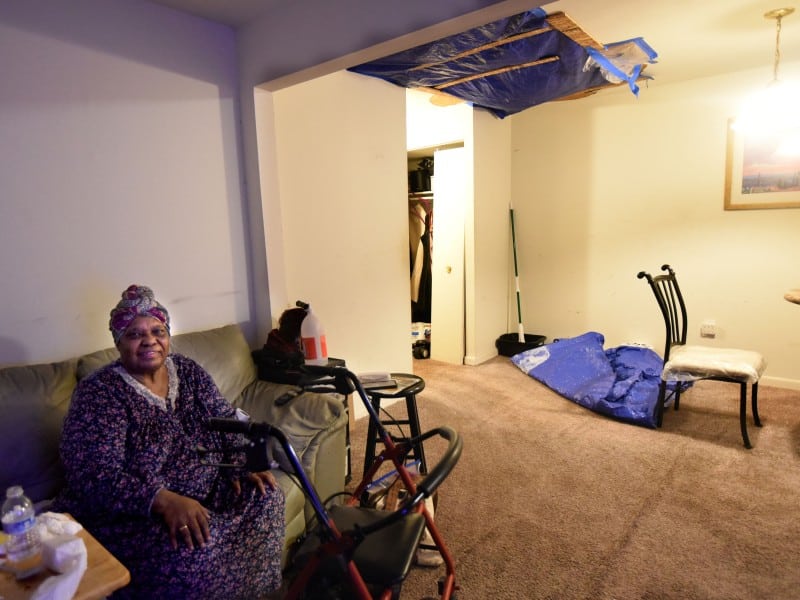
Feces, Rats, Neglect: Camden Tenants Detail Housing ‘Nightmare’
Residents of three Conifer Realty properties say years of neglect have created a public health crisis.

Camden Is Burning: EMR And The NJ Political Machine
Behind the toxic smoke at European Metal Recycling lies a $6.7 million deal and a network of political influence that leaves Camden’s Black and Latino residents in the line of fire.

A City Surveilled
Camden operates the largest drone program in South Jersey with little regulation. But whose safety does it really serve?