
Newark Symphony Hall Celebrates 100 Years With Massive Restoration Project
New Jersey’s iconic Black-led arts institution is getting a high-tech facelift, including new TV studios and an arts lab by fall.
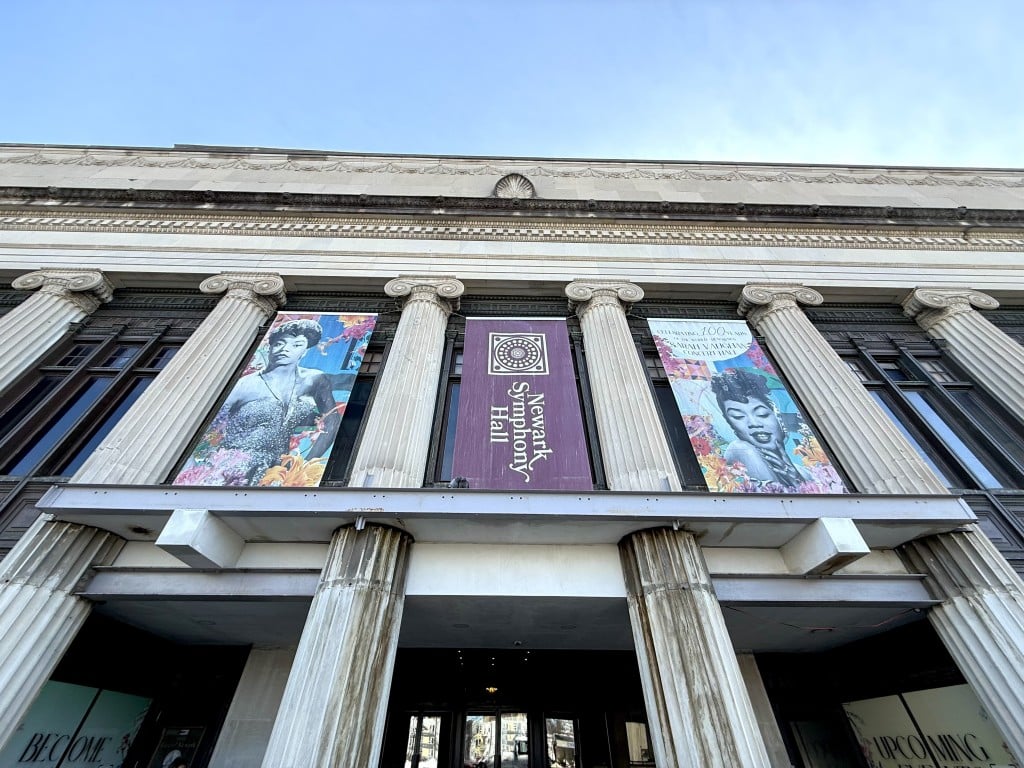
As New Jersey nears the end of Black History Month, Newark Symphony Hall honored its legacy as the Garden State’s largest Black-led arts institution with a glimpse into its revitalization project on Wednesday.
Spanning 220,000 square feet, Newark Symphony Hall opened in 1925 as the Salaam Temple and has since grown into an artistic, cultural, and entertainment hub in New Jersey. In its early days, the NSH held vaudeville acts, symphony orchestras, and screenings for newly invented sound films.
Known as Newark’s First Stage, the Hall has hosted such renowned performers as Leonard Bernstein, Aretha Franklin, Judy Garland, Tony Bennett, Richard Pryor, Queen Latifah, The Rolling Stones, Jimi Hendrix, and The Beatles.
According to Newark Symphony Hall CEO Talia Young, the Hall attracts people residing all throughout the Garden State, as well as Pennsylvania and New York. As a result, Young said that the Hall’s restoration will have a “huge” economic impact on Newark and New Jersey as a whole.
“We’re making sure that there’s always a space for us, our stories to be told, our story to be invested in. Every time you think about a performance happening, there is a business behind [it],” said Young.
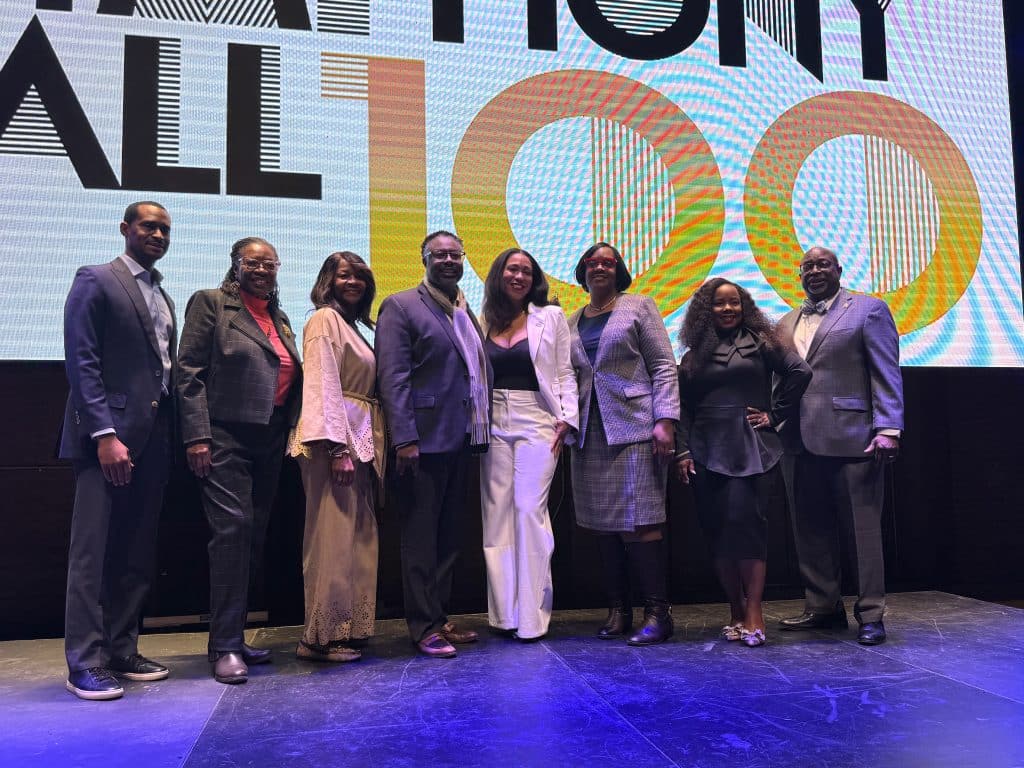
Lawrence Crump (center left, scarf) posing with a group of people in Sarah Vaughan Concert Hall in Newark on Feb. 26, 2026. Photo credit: Anthony Orlando for NJ Urban News.
Newark Symphony Hall has secured over $23 million in funding for its restoration, which includes over $18 million from the state of New Jersey, $3.5 million from the City of Newark, and $1 million from Prudential Financial. This multi-phase project has also received the support of local elected officials, including Newark Mayor Ras J. Baraka, Lt. Governor Dr. Dale Caldwell, state Sen. Teresa Ruiz, state Assemblymember Eliana Pintor Marin , and Newark Council President Lawrence Crump.
“Newark Symphony Hall has stood for nearly a century as a cultural anchor,” said Crump, who is also a member of the Hall’s board of directors. “The board is proud to support an organization that has demonstrated both vision and execution, advancing a multi-phase restoration while expanding programming, partnerships, and impact.”
Newark Symphony Hall has already revealed a bold, new logo and finished restoring its historic Terrace Ballroom. The next phase of this ambitious project will involve revitalizing the building’s marquee by redesigning and installing LED lights on its limestone façade.
The Hall will also add a new 30,000 square-foot arts and education lab on its second and fourth floors, which will train and pave career pathways for writers, dancers, musicians, and artists of all ages. This lab will feature state-of-the-art technology, practice rooms, dance studios, and a learning center for interactive programs and classes.
The third floor will also be transformed into the new location for Newark TV Studios. This office space will offer production studios and editing rooms, and a private screening room.
The Hall will also redesign its famous, multi-purpose Black Box Theater, which will galvanize New Jersey’s already-growing film and TV production industry. In addition, the Hall will renovate and modernize both its lobby and its historic main stage, the Sarah Vaughan Concert Hall, transforming the latter into a high-end 2,800-seat venue.
According to Young, the Hall will finish restoring its fourth floor, third floor, and marquee by the end of October 2026. With so many improvements coming later this year, Newark Symphony Hall seeks to promote, preserve, and expand itself in order to honor its legacy as a linchpin of New Jersey’s diverse cultural and artistic landscape.
“Our stage is comparable to Carnegie Hall, and this is the artistry of what was made 100 years ago,” said Young. “So I think it’s really our responsibility to invest [in] it and make sure it’s stable and it’s sound for the next 100 years of the artists and the diverse culture to live here.”
Related Articles
The Hidden History of the Black Comedians Who Rewrote American Humor
They didn’t just tell jokes; they acted as America’s conscience. Discover the grit, the glory, and the hilarious rebellion behind Geoff Bennett’s “Black Out Loud.”
Rann Miller Honored With 2026 Excellence In Community Media Award
The award ceremony was presented by the Center for Cooperative Media at Montclair State University