Northeast Pipeline Project Allowed To Disrupt Marine Wildlife
Feds approve pipeline plan letting a fossil fuel company disturb whales, dolphins, and other marine life in Raritan Bay.
By: Benjamin J. Hulac, Washington Correspondent
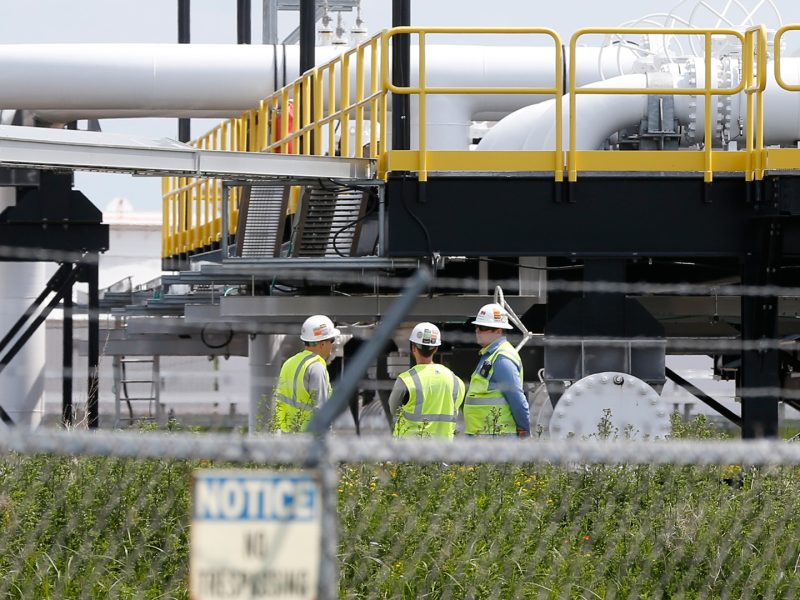
WASHINGTON — National fishing authorities granted a fossil energy company’s request for permission to disturb marine wildlife in Raritan Bay as part of an ongoing construction pipeline project.
The approval, issued Tuesday by the National Oceanic and Atmospheric Administration, allows the Williams Company to disturb 15 varieties of whales, seals, porpoises and dolphins, as it builds a 24-mile pipeline on the floor of the bay.
Williams, an Oklahoma company, requested permission after this spring reviving the pipeline effort, called the Northeast Supply Enhancement Project, following years of legal disputes.
The Federal Energy Regulatory Commission, an independent body that oversees pipelines, issued its own approval of the project in late August.
Revived natural gas pipeline plan includes major disturbances in Raritan BayTo be built, the pipeline requires approval from the governors of New York and New Jersey, both Democrats under pressure from environmental and local conservation groups to block the project.
Beyond running a roughly pipeline about two feet in diameter beneath the bay, Williams wants permission to build 3.6 miles of pipeline in Middlesex County, a new compressor station in Somerset County and about 10 miles of pipeline Lancaster County, Pennsylvania.
Construction in the bay would start next year, according to Williams, and require drilling more than 160 piles into the ocean floor, a highly mechanized process that uses diesel-powered hammers, pistons and other vibrating tools.
“To run a needless pipeline across twenty-three miles of Raritan Bay, going through wetlands and then slicing through marine habitat and clam beds, it makes no sense to use,” Greg Remaud, CEO of NY-NJ Baykeeper, a local environmental group, said in a recent interview with NJ Spotlight News.
Federal law bars “takes” of marine mammals — a broad term that can mean hurting, chasing, capturing, torturing or killing an animal — yet provides exemptions for certain purposes, such as scientific research, the U.S. military or construction.
In documents released this week, NOAA said it did not expect any animals to die because of the construction work. “Harassment is the only type of take expected to result from these activities,” the agency said in a public notice.
Representatives of NOAA did not respond to inquiries about why the agency granted approval to Williams, which also did not respond to inquiries.
The pieces Williams wants to build would link the New York metropolitan area to the broader Transcontinental, or Transco, gas pipeline network, which spans 10,000 miles total, and the Gulf of Mexico, a significant oil and gas producing region.
A growing population in New York justifies a new pipeline, Williams has said. A portion of the pipeline planned to be built under the bay would connect to land in Sayreville and Queens, in New York.
“As demand continues to grow, especially in densely populated areas like Brooklyn, Queens, Staten Island, and Long Island, so too must the capacity to deliver reliable energy,” the company said in a project summary.
Loud sounds such as heavy construction can disturb ocean animals and generate long-term consequences, as researchers found in a 2022 study published in the International Journal of Environmental Research and Public Health.
“Marine mammals live in a habitat that transmits little light but through which sound propagates well and quickly, even over great distances. For this reason, marine mammals rely on sound to communicate, explore the environment, find their prey and avoid obstacles,” the researchers wrote. “Noise can increase the risk of death by modifying the delicate balance between predators and prey, interfering with the use of sounds in communication, especially in relation to reproduction and navigation.”
Related Articles

‘Forever Chemicals’ Could Soon Be Banned From Period Products In NJ
New Jersey advances a bill to ban PFAS “forever chemicals” from menstrual products to protect public health and the environment.