
Trump Administration’s Moves To Stifle Dissent Cause Alarm
Trump’s removal of a decades-old Lafayette Square protest sparks concerns over silencing dissent and democracy.
WASHINGTON — Few people noticed when the Trump administration removed a peaceful anti-government demonstration from Lafayette Square, the park just across Pennsylvania Avenue, north of the White House.
But it’s the sort of action people should notice, because it’s the sort of action authoritarian leaders take, free-speech experts and civil rights attorneys said in interviews with NJ Spotlight News.
“I have worked as a human rights attorney all over the world and have fought back against this playbook,” Hadar Harris, managing director for Washington, D.C., at PEN America, a literature and human rights group, said in an interview with NJ Spotlight News. “It is disturbingly familiar.”
On Sept. 7, police with the Interior Department cleared the vigil site, a flag-marked tent that volunteers had manned around the clock since the early 1980s. The vigil was widely thought to be the longest-running act of political protest in the nation.
“It’s dismantled,” Rep. Jeff Van Drew (R-2nd) said in an interview last week with NJ Spotlight News. “I absolutely believe in the right for people to demonstrate, to rally, freedom of speech. To speak their mind. This was an encampment,” he said. “A demonstration isn’t that you live there for years in a tent.”

Going after critics
Since he returned to the Oval Office in January, President Donald Trump has made squelching dissent and sidelining critics hallmarks of his administration, from extracting financial agreements from law firms and universities to firing federal officials and dispatching troops to politically left-leaning cities.
In the nine months that followed, Trump or top officials in his administration have fired many who disagree with or criticized him, including the former heads of the Bureau of Labor Statistics, the Centers for Disease Control and Prevention and the Kennedy Center. Trump organized a military parade on his birthday, illegally froze federal money Congress had approved and flirted with the idea of running for a third presidential term — something barred under federal law.
In a May 8 letter to Interior Secretary Doug Burgum, who oversees the U.S. Park Police, which has jurisdiction over Lafayette Square, Van Drew said the administration should consider removing the demonstration.
In New Jersey, Newark Mayor Ras Baraka and Rep. LaMonica McIver (D-10th), both staunch Trump critics, have been indicted on federal charges by the U.S. attorney for New Jersey, Alina Habba, a Trump loyalist and former personal attorney to the president.
While the charges against Baraka were dropped, charges against McIver are still active — her trial is scheduled to begin in November — and prompted a Republican attempt to strip her of a committee assignment and censure her. Mahmoud Khalil’s is another high-profile case under the Trump administration. Khalil is being prosecuted in New Jersey over his role organizing pro-Palestinian protests against Columbia University in 2024.
Trump sends troops
“We have direct connection to the Trump administration’s attempts to silence dissent in our state,” Amol Sinha, executive director of the ACLU of New Jersey, said in an interview with NJ Spotlight News.
Trump administration fights obstacles to its deportation agendaSinha said New Jersey leaders should brace for military troops coming to the state, as they have in Washington, D.C., where soldiers with rifles and in fatigues greet subway riders on their morning commutes, and over the summer in Los Angeles.
“New Jersey isn’t too far down that list,” he said. “This isn’t happening in some far-off place.”
As a democracy, the U.S. has slid 11 points in 13 years in the rankings of Freedom House, a Washington-based nonprofit that studies democratic risks.
In other research rankings, many foreign governments have scored lower on freedom and higher on repression in the last decade, said Lee Rowland, executive director of the National Coalition Against Censorship.
“Censorship is not owned by any particular politics or any particular administration,” Rowland said in an interview with NJ Spotlight News. “People in power tend to find censorship an appealing and seductive tactic.”
The Lafayette Square protest
Like other free-speech experts, Rowland said the vigil’s location, directly facing the home of the president, was important. “It is a fitting parallel to have a visible source of public dissent,” Rowland said. “Very few things are more American than that tradition.”
In a May 8 letter to Interior Secretary Doug Burgum, who oversees the U.S. Park Police, which has jurisdiction over Lafayette Square, Van Drew said the administration should consider removing the demonstration.
“Even if I strongly disagree with many of the wrong and distasteful messages advocated for by this protest, Americans have every right to protest their government,” Van Drew wrote. “But they do not have the right to hijack a national park and turn it into a 24/7 eyesore.”
‘None of this is normal. What is happening here in Washington is not happening only here in Washington.’ — Hadar Harris, PEN America
Van Drew talked about aesthetics too. “It looks bad for the capital. It was ugly. It loses its meaning when you are just there day after day, week after week, year after year, administration after administration,” he said in an interview.
An Interior spokeswoman referred questions about the vigil’s removal to the White House.
“President Trump is committed to the public safety of DC residents and visitors, as well as the beautification of our nation’s capital. This tent was a hazard to those visiting the White House and the surrounding areas,” said White House spokeswoman Taylor Rogers by email.
Asked for specific examples of when the site was a public hazard, Rogers did not reply.
Removal of the tent came after Trump in August ordered National Guard troops to Washington, arguing the deployment would help lower crime, which had reached a 30-year low, according to FBI data.
A long history
The vigil began in 1981 to prod for nuclear disarmament and an end to global conflict. It included a yellow sign, in all black capital letters, that said, “LIVE BY THE BOMB DIE BY THE BOMB.”
“Visible public dissent, like the peace vigil, really stands for the very core of what we should treasure in our culture, which is the ability for every person to have a little bit of power to be heard by those who actually control the country,” Rowland said.
“It was kind of an iconic part of walking by the White House,” Katie Fallow, deputy litigation director at the Knight First Amendment Institute at Columbia University, said in an interview with NJ Spotlight News of the demonstration.
“It was always there through every president,” said Fallow, a former Washington, D.C., resident. “It had a symbolic value,” she said. “Under the First Amendment in America, you can criticize even the most powerful officials and you can do it right in front of the White House.”

Trump has also written executive orders that punish law firms that have supported causes or clients he or his administration dislike.
Trump administration makes it harder for students to learn EnglishSeparately, agencies like the Federal Communications Commission and the Federal Trade Commission have taken steps to punish Trump critics and watchdog organizations, such as Media Matters, a liberal group under FTC investigation.
“The goal of all of this is to get these organizations to change their speech or not express viewpoints that the government doesn’t like,” Fallow said. “That’s dangerous and likely unconstitutional.”
The administration has also used federal funding, like grant money, as leverage to suppress speech its leaders dislike, said Harris, of PEN America.
“None of this is normal,” she said. “What is happening here in Washington is not happening only here in Washington.”
Related Articles
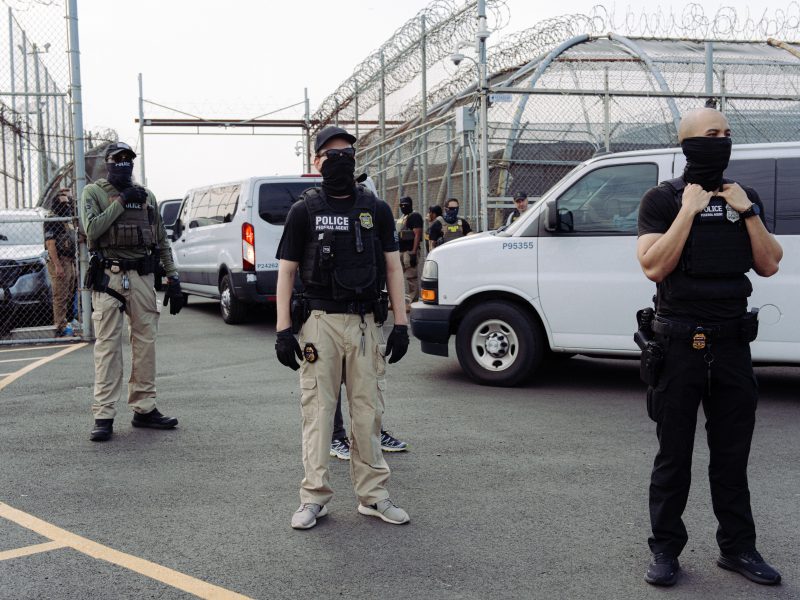
Sherrill Signs NJ’s Landmark Immigrant Protection Laws
The bills protect immigrant residents’ private information and limit how local police can interact with ICE officers.
Gov. Mikie Sherrill: Ethnic And Community Media Shed Light On ‘Untold Local Stories’
U.S. Sen. Andy Kim, NJ Sen. Raj Mukherji highlight the need for truthful, reliable news media at the 2026 NJ Excellence in Community Media Awards.

In Rare Bipartisan Burst, Congress Close To Historic Housing Law
With the nation short millions of residential units, bill may stall because Trump says he’ll sign nothing unless voting curbs are passed