
Newark Braces For Flight Cuts Ahead of Busy Memorial Day Weekend
There will be less flights in and out of Newark Liberty International Airport (EWR), a major travel hub for the New York Metropolitan Area, ahead of a record-high air travel weekend.
On Tuesday, the Federal Aviation Administration (FAA) announced its plans to cut flights at the airport by about 25%, effective immediately. The move comes in response to a cascade of aviation issues at the airport, including alarming technology outages and staffing shortages, resulting in flight delays and cancellations.
“Our goal is to relieve the substantial inconvenience to the traveling public from excessive flight delays due to construction, staffing challenges, and recent equipment issues, which magnify as they spread through the National Airspace System,” said Acting FAA Administrator Chris Rocheleau in a statement.
The airport, which previously handled 77 arrivals and departures per hour, will now operate with a reduced schedule of just 56 flights per hour until June 15, when daily runway construction is expected to end. The hourly flight cap will rise to 68 until October, with Saturday flights remaining limited to 56.
On May 20, the Federal Aviation Administration reported that it began investigating a two-second radio outage at Philadelphia TRACON C, which guides aircraft in and out of Newark’s airspace. This marked the airport’s fourth technological issue this month, according to The Independent.
Another outage on May 9 also made headlines, impacting communications and radar display at Philadelphia TRACON C. At the time, there was reportedly only one air traffic controller on duty for Newark airport at the time of the blackout, which lasted 90 seconds.
Staffing shortages exacerbated the outages, United CEO Scott Kirby said, when a reported 20% of its FAA controllers “walked off the job.” According to The Guardian, this brought the number of on-duty controllers down from 14 to three, and the unionized air traffic controllers who left had gone on trauma leave following intense pressure on the job.
Air traffic controllers have voiced their concerns with flight issues at Newark airport . The lone controller on duty during the May 9 blackout spoke to The Times, saying the incident forced her to take trauma leave. She also shared fears for Newark airport, saying she “deliberately avoids [her] own airport when booking flights, even if the alternatives are more expensive and less convenient.”
“If Newark’s air traffic control problems don’t get fixed, I believe it’s only a matter of time before we have a fatal crash between two planes,” she told The Times.
After investigating EWR’s outages, Sean Duffy, the Secretary of the U.S. Department of Transportation Sean Duffy, tweeted that they resulted from “outdated equipment,” emphasizing the need for an improved air travel control system.
“We are working to harden the system. But this is why it’s critical that we build an all-new air traffic control system,” he wrote.
Scott Kirby has shared public statements about long-standing issues at Newark airport, where United operates around 70% of its flights. The FAA regularly approves of 80 plus flights almost daily from 3 to 8 p.m., according to Kirby.
Kirby also claimed that United has spent years trying to convince the government to limit the number of flights coming into the Newark airport, which he called “chronically understaffed.”
“Without these controllers, it’s now clear – and the FAA tells us – that Newark airport cannot handle the number of planes that are scheduled to operate there in the weeks and months ahead,” Kirby said in a May 2 statement.
After meeting with airline representatives from May 14 through 16, the FAA announced that it is taking “immediate action” to accelerate air traffic control staffing and install new technology at Philadelphia TRACON C to increase bandwidth, speed and efficiency.
The clock is ticking, as the FAA announced that 2025 will have its “busiest summer in the last 15 years.” They anticipated a record-high of roughly 54,000 flights nationwide on May 22,
The FAA also predicts increasing flight numbers each week throughout the summer, with Thursdays being the busiest days. Flight numbers are expected to peak at the end of July, with at least six 54,000+ flights days before August ends.
Related Articles
Newark Symphony Hall Celebrates 100 Years With Massive Restoration Project
New Jersey’s iconic Black-led arts institution is getting a high-tech facelift, including new TV studios and an arts lab by fall.
Wali Bey, 42, Identified In Deadly Newark Police Shooting
NJ officials identified the man and officer involved in a fatal Newark police shooting now under investigation by the Attorney General.
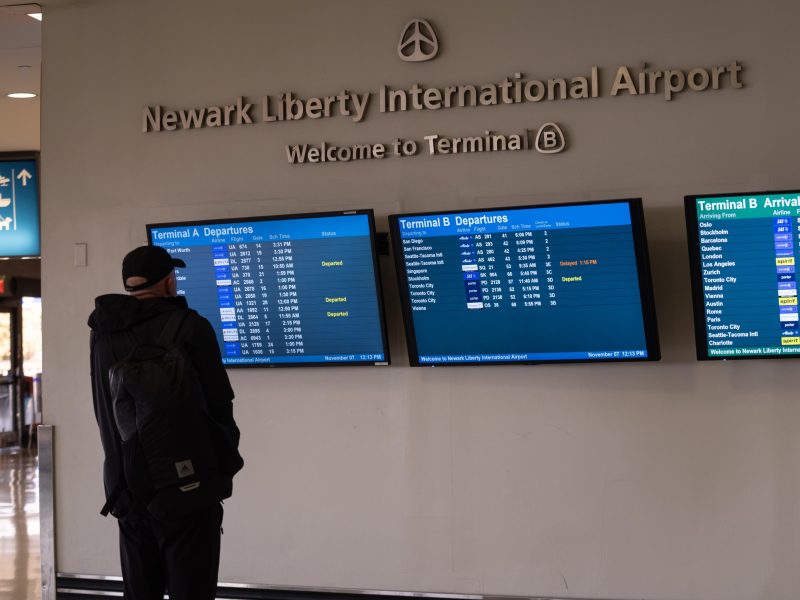
Why Newark Liberty Airport Keeps Appearing In Measles Exposure Alerts
Newark Liberty’s repeated measles exposure alerts highlight how heavy travel and a national measles resurgence increase risks at major U.S. airports.