Low Turnout and High Prices: Examining Newark’s Housing Crisis and Voter Disengagement
The City of Newark has witnessed a sharp decline in voter turnout during elections in recent years. As Newark Mayor Ras J. Baraka and his administration continue to tackle homelessness and provide affordable housing in the city, one can’t help but wonder if this will positively affect future election participation.
According to NJ.gov, Newark’s last mayoral election in 2022 saw 16% of its registered voters turnout at the polls (voter turnout was 20% the previous year). Though registered voters increased by almost 1,000 in 2023, the percentage of ballots cast fell to around a staggering 9%.
While voter participation has decreased, so has homelessness. Mayor Baraka claims that the New Jersey Department of Community Affairs annual report shows that the number of people experiencing “unsheltered homelessness” decreased by 57.6% from 2022 to 2023. It’s unknown whether or not the ballot count will turn around in 2026, especially since Baraka promised to increase affordable housing.
Despite the existence of a relationship between the percentage of community members experiencing homelessness and voter turnout, there are other factors contributing to Newark’s low voter participation rates.
NJ.gov shows that the number of voters has fluctuated between 2018 and 2022, with relatively high percentages in the 2018 mayoral election, the 2020 presidential election, and the 2022 mayoral election. This data points to the potential impact of the type of candidate and how they may inspire or encourage the public to vote, leading to greater participation.
“I would think that the disengagement of residents in terms of feeling that they can influence what’s happening in their lives on a daily basis in the city is certainly reflected in low voter turnout,” said Vivian Fraser, CEO of the Urban League of Essex County. “You hear people say, ‘Well, one vote is not going to make any difference.”
The barriers of voter engagement
In 2020, the New Jersey Institute for Social Justice (NJISJ) published a report titled “Our Vote, Our Power: Lifting Up Democracy’s Voices.” According to this report, the NJISJ has found four barriers that have reduced the state’s voter participation:
- Lack of Voter Knowledge: Many voters don’t know enough about elections, candidates, and how government works.
- Systemic Barriers to Voting: Obstacles “ranging from registration challenges to busy schedules on a weekday.”
- A Restricted Electorate: Laws that prevent incarcerated and young people from voting.
- Limitations to our Representative Democracy: Too many people believe the system doesn’t respond to them and that “winners are predetermined.”
Though the Baraka administration has reduced the number of people experiencing unsheltered homelessness in Newark, that alone doesn’t change the education and misinformation residents receive about voting.
There is also the matter of income. According to a study by Econofact, the percentage of people who voted in the 2016 Presidential Election was proportional to the voter’s income. This association between voting and higher income can be credited to the voter having more time, better health, and access to better education and transportation.
Residents with low incomes may only attend schools that teach them some of what they need to know about voting in person or remotely. They may also have to work jobs that prevent them from going to polling stations on Election Day. And even if they did, they may need the means to travel to the polls to cast their ballot.
Combining all this with the belief that one person’s vote won’t matter and their voice won’t be heard, voters will prioritize making a living and paying bills over participating in elections. While unsheltered homelessness has decreased in Newark, low income remains a significant issue affecting people’s decision to vote, as the cost of living has kept them from the polls.
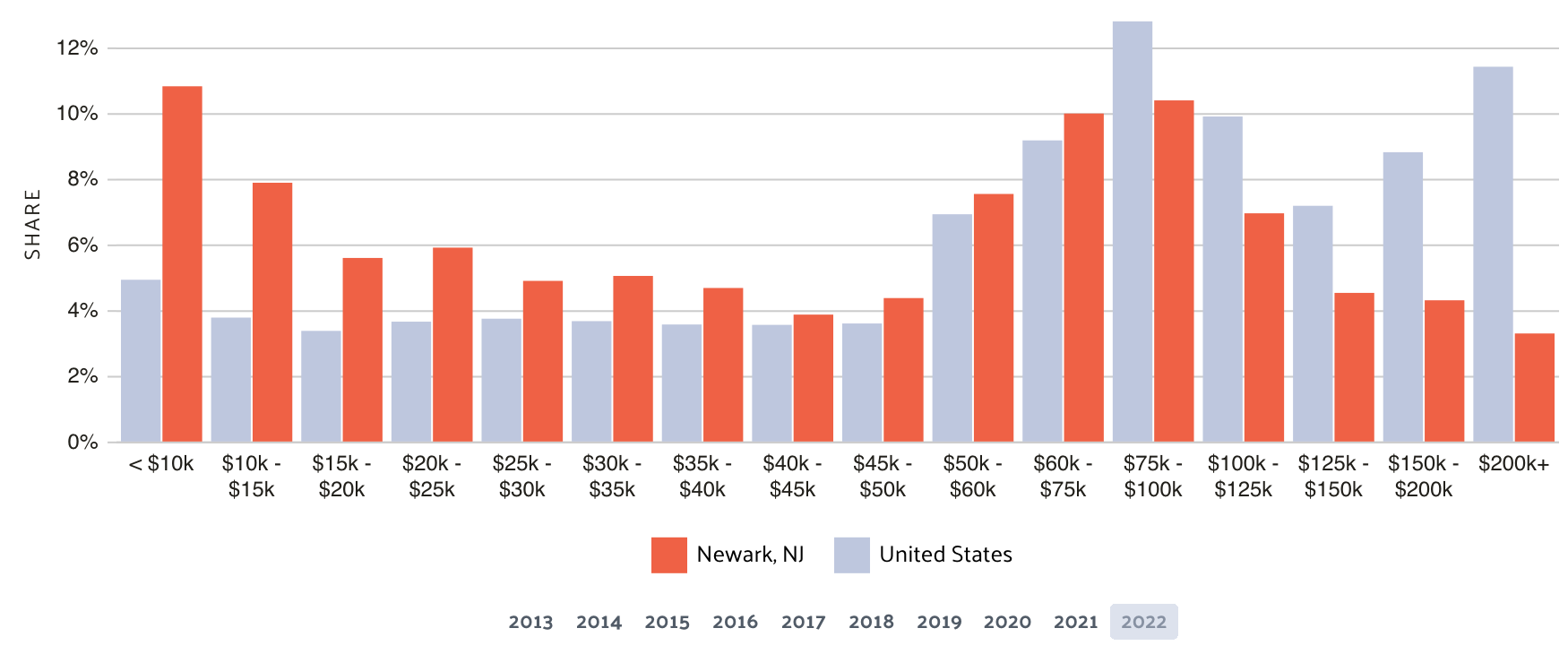
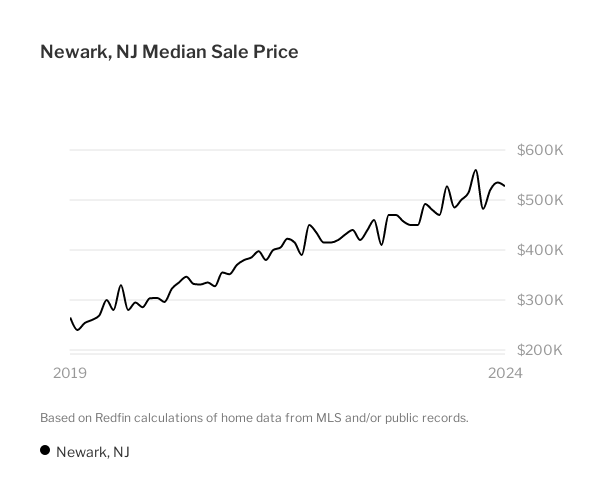
The United States Census and Data USA shows that in 2023, Newark’s Median Household Income increased from $46,460 to $53,818. However, Redfin claims that in September 2024, the Median Sale Price was $527,500, having been $420,000 in January 2023 and $269,000 in 2020. This data shows that the rise in residents’ income can’t keep up with rising house prices, leaving them in the dust and unable or unwilling to vote.
What Needs to Be Done
Housing in Newark is just one of several issues that need to be tackled to increase voters. Residents need the knowledge, confidence, and availability to participate in their city’s elections. However, raising homeownership rates and residents’ quality of living can increase their investment in their community and provide them with more voting opportunities.
Fortunately, according to Patch, the City of Newark recently lowered its voting age to 16 for school board elections. Governor Phil Murphy also signed a new law that will lower New Jersey’s voting age in primary elections to 17. This new legislation should allow younger, more eager voters to participate in elections and bring change to their community.
But at its heart, the issue of low voter turnout comes down to people feeling like their votes matter and that the government is hearing their voices. Vivian Fraser best explained how people need to see the value of their vote and how previous generations fought so hard for it:
“We’re removed generationally from the Civil Rights Movement and people who understood that they were denied the right to vote. Voting was integral to their citizenship, which they did because they knew the vote was fragile. They knew it could be taken away from them, so they cherished that vote…. Maybe recent events will inspire people to understand that just because you had a right, doesn’t mean you’ll keep that right and that rights must be defended.”
This story was produced as part of the NJ Black Publishers Election 2024 Collaborative Coverage, in partnership with the Center for Cooperative Media at Montclair State University. The following is a list of participating newsrooms: New Jersey Urban News, Ark Republic, Atlantic City Focus, Black in Jersey, Echo News TV, Faithfully Magazine, Front Runner, Trenton Journal, Trenton 365