The Right to Rebel
On Friday, July 12, 2024, the People’s Organization for Progress” held its annual rally commemorating the lives lost in the 1967 Newark uprising. Besides remembering the fallen, Larry Adams said people need to understand that there was an apartheid state in Newark at the time.
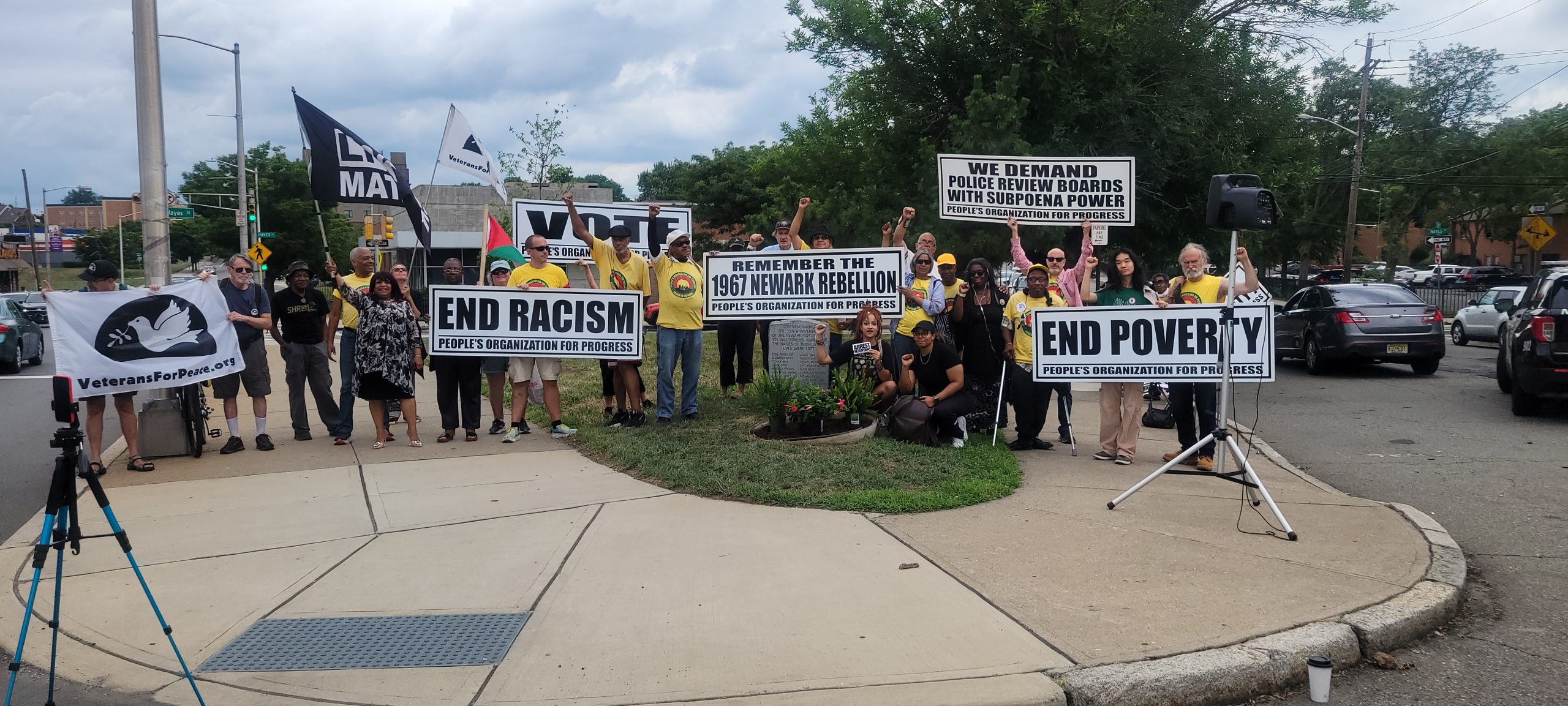
About a dozen people gathered at first on Friday at the monument erected in memory of the lives lost. It sits at what is unofficially known as Rebellion Park, located on Springfield Avenue between Hayes Street and Irvine Turner Boulevard in Newark. The crowd would later swell to about 40 participants who marched about half a mile to 10 17th Avenue, the site of the 1st Police Precinct in 1967.
Fifty-seven years ago, the violent civil unrest ignited after an incident of police brutality at the 1st Police Precinct. First-hand resident accounts say police officers had beat a Black cab driver named John Smith. According to the New York Times, police said Smith was arrested and injured.
Nevertheless, what followed was five days of protest, violent clashes, and death. When the smoke cleared, 1500 had been arrested, and the 26 names etched in the stone monument at Rebellion Park were all dead.
New Jersey governor Richard Hughes had called the National Guard into Newark, who drove army tanks down urban streets. “It was like we were a colony, struggling for independence,” POP Chairman Larry Hamm spoke through a microphone and speaker at Rebellion Park. Although the rally on Friday took place in the early evening, temperatures sweltered in the 90’s. Cars riding by honked at POP members holding signs that read:
Remember the 1967 Newark Rebellion
We Demand Police Review Boards with Subpoena Power
End Racism
End Poverty
Hamm continued: “We had to have a revolutionary transformation. We had to have a revolution.” Hamm read each one of the names aloud as flowers were laid in their memory on Friday.
Hamm, who ran for United States Senate last November, was a 12-year-old Newark youngster when the city was halted in ‘67.
Two other speakers who lived in the neighborhood during the rebellion spoke about their experiences, Dr. Linda McDonold Carter and James Jackson. “I was 18 years old when it happened. I ran over there [to the first precinct]. State troopers were shooting at the projects. The people were putting out white sheets so they could stop shooting,” Jackson recalled.
It was not lost on the crowd that the march was to 10 17th Avenue, the former address of what residents called the “notorious” first precinct. Jackson said Blacks went in, and some never made it out alive when he was growing up. The site has been transformed today into the home of the Office of Violence Prevention and Trauma Recovery, created in 2020. Director Lakeesha Eure addressed the crowd on Friday about the office’s work.
While waiting for one of her students to arrive at the rally, Emani Miles, who teaches Newark history at American History High School in the city, pointed to the positive changes due to the rebellion in ‘67. “The impact that it made today, not only in the Central Ward [of Newark] but everywhere like the EOF programs, Upward Bound, and all the results that happened because people decided to fight, really for their liberation.”
At the rally, Hamm made a fresh set of demands: “I call on Governor Murphy to make the appointments to the commission for the Seabrooks-Washington legislation.” Signed by the governor in January 2024, this legislation supports community response crisis programs in the state. He also called for legislation to create Civilian Complaint Review Boards in New Jersey with subpoena power.
Nationally, Hamm called on Congress to pass the George Floyd Justice and Policing Act of 2024 and for President Biden to appoint a Kenner commission for the 21st century.