
Statistics Don’t Lie: Black Dads Are More Involved in Their Children’s Lives.
Another Father’s Day has recently come and gone, reminding Americans of the pivotal role that dads play in their children’s lives, the challenges they often face, and the negative ways in which many fathers are routinely perceived.
And while some fathers may have added a few more golf balls, neckties, grey flannel socks, and Fruit of the Loom underwear to their assortment of Father’s Day goodies, others watched the day go by with little or no fanfare.
For the latter group of fathers, words like “absentee,” “deadbeat,” – and even “sperm donor” – count as just a few of the negative terms that dominate conversations and critiques about them. And when the spotlight is illuminated on Black fathers, it’s not unusual for debates about their contributions and commitment to their children – or lack thereof – to become even more provocative.
But the times are changing – a change first observed just over ten years ago after an iconic study, which continues to be cited, revealed that Black dads willingly step up to the plate when given the opportunity. Despite high divorce rates, low marriage rates, and huge disparities in rates of incarceration, an increasing number of Black fathers are putting their children first in their lives, no matter what the cost.
Statistics confirm it’s time to change the narrative about Black dads
The CDC study found that Black fathers who live with their children were more likely than white or Hispanic fathers to bathe, change, or dress their children every day, more likely to eat meals with their children every day, and more likely to help their children with their homework every day.
Negative stereotypes notwithstanding, the landmark CDC National Health Statistics Report revealed that when it comes to Black fathers who live with their children, a surprising 70% remain more involved across a range of nurturing and involvement activities, compared with their white (60%) or Hispanic (45%) counterparts.
The 2013 study also found that while 52% of custodial mothers in the U.S. are Black or Hispanic, nearly two-thirds of custodial fathers are white. Now, more than a decade later, race and ethnicity continue to impact the likelihood of a father living apart from his children.
Consider that 44% of Black fathers live apart from at least one of their children, compared to 21% of white fathers. For fathers with young children, the pattern remains the same: 32% of African American fathers live apart from children under five, compared to 10% of white fathers.
These findings may serve as something other than fodder for headline news. However, at the very least, they illustrate the importance of America reshaping the public narrative, which has long operated under less-than-accurate assumptions, and recasting Black fathers’ notions of Black fatherhood in a more positive light.
As a single father, Thabiti Boone took ‘the road less traveled’
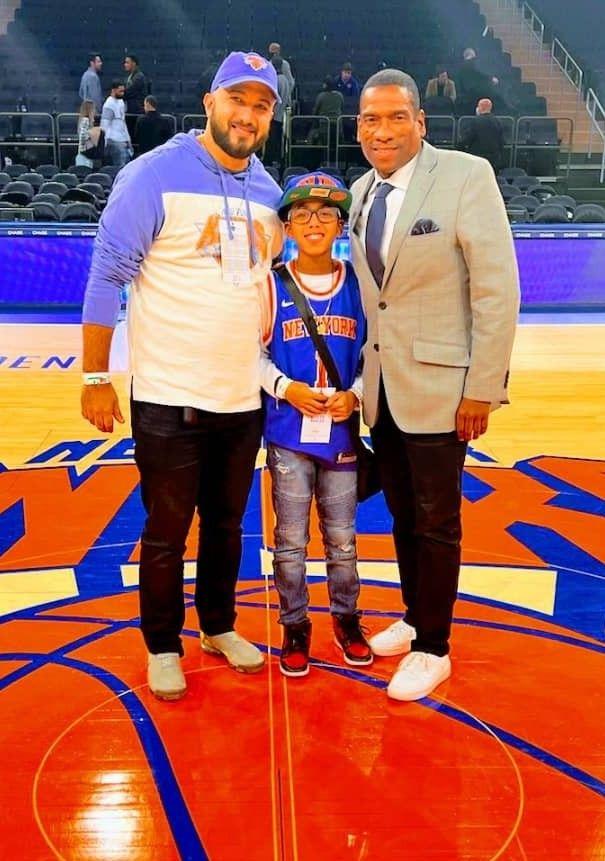
Thabiti Boone, in charge of community relations for the New York Knicks, is a resident of Union County, New Jersey, and a highly respected advocate for the interests of fathers, Black men, and boys, especially in the service of arguing for more substantive, greater mental health support for them. He said he remembers the day many years ago when he was forced to choose between pursuing his dreams and accepting the responsibilities of fatherhood.
As a standout on his high school basketball team and with a college scholarship looming, Boone, who then had dreams of becoming an NBA superstar, learned that his girlfriend was pregnant. What he did next would impact and shape the rest of his life.
“I received a scholarship to play in Florida, but the coaches told me college was not a place for a child and suggested that I put her up for adoption,” he said. “I told them and the university, it’s me and my daughter – and that’s it. So, they let us both come.
“I gave up my dream of playing in the NBA to do everything I could for my child—the love of and responsibility for her rose above everything else. I had to build my support team, so I did. And I graduated even though many people told me it was impossible. What I wasn’t prepared for was being hit with depression,” Boone said.
Boone has shared his tale of resilience and how he overcame his mental health challenges with audiences nationwide, including one group that gathered for the 2023 Central Texas African American Family Support Conference in 2023. As the keynote speaker, he presented “Black Manhood and Fatherhood: A Discussion on Mental Health.”
He remains convinced that his humility and willingness to share his truth garnered the attention of the Knicks, establishing and solidifying a relationship with the organization that has continued for the past 25 years.
“I was speaking at a Knicks event – that’s how I first became involved with them,” he said. “I’ve gained a lot of respect – ultimate respect among both their staff and players – for putting my dreams aside to put my child first and to always be in her life. That’s how I came to the attention of President Barack Obama.”
Obama tapped Boone to join his team early in his presidency as he was developing his Fatherhood Mentoring Initiative. During his eight years with the Obama Administration, Boone helped spearhead what would become the first-ever White House convocation on Black men and mental health.
“I learned a long time ago, even before the Knicks or with President Obama, that the greatest home run we can hit, the most incredible shot we can make, is being responsible fathers and loving our children. Life doesn’t end because circumstances occur, and you unexpectedly become a dad. When you understand that, when you get it, you realize that things will eventually fall into place if you keep pushing.
“We cannot allow ourselves to become victims or play the victim. Sure, Black fathers – all fathers – have issues and circumstances. But you can’t just say you love your child and then be unwilling to do the work like holding down multiple jobs, paying child support, and yes, being positive with your child’s mother, even when you’re not together. I learned that when you’re guided by that spirit, the hearts and minds of individuals and institutions will open for you and for your child,” Boone said.
Comments (4)
Comments are closed.
Related Articles
Founder Of NYC’s First Black Daily Newspaper Dies At 88
Thomas H. Watkins, pioneering founder of NYC’s first Black-owned daily, has died at 88, leaving a lasting impact on the Black Press.

Once A Patient’s In Custody, ICE Can Be At Hospital Bedsides — But Detainees Have Rights
ICE can monitor detained patients in hospitals, but detainees still have rights to privacy and legal access.
So the most active father also has highest statistics of abandoning their children. Y’all really need to stop manipulating that CDC study. Until the problem is acknowledged, it will never be fixed.
We simply report the facts as presented. The CDC study on it’s face isn’t something we would alter or change.
2st time I’ve seen this publication, and it’s on FB. A trip, or what??
We hope you’ll be able to subscribe. We’ve been in the business since 2020, and we’re based in Newark and cover urban areas in New Jersey.
We appreciate your readership. Thank you.