
Rutgers Protest on Palestine Ends, University Accepts Students Demands
By Allyssa Bovasso-Pignataro NJ State House News Service
Students ended a four-day pro-Palestinian protest at Rutgers University on Thursday evening after Unversity President Jonathan Holloway said the school would meet most of the students’ demands, including an amnesty for student protestors.
Protestors, ecstatic about their victory, began breaking down the tent encampment on Voorhees Mall, at the College Avenue campus in New Brunswick, as Rutgers University Police Department officers kept watch over the area.
Final exams on Thursday morning were postponed on the College Avenue Campus as an email from the university warned of an “anticipated escalation” in the protest.
In all, the university said about 1,000 students and 28 scheduled exams were affected by the delay.
“We understand the importance of exams and the impact that any disruptions can have on our students’ academic progress. We are committed to doing everything in our power to provide a safe and secure environment for our students to learn and succeed,” Holloway said.
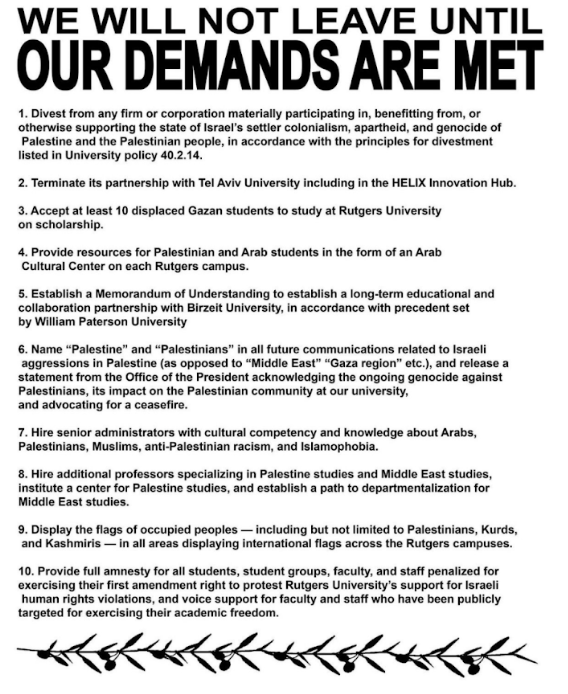
The university met with protest leaders in the morning in an attempt to de-escalate the situation and ultimately agreed to meet the protestors’ list of demands.
Protesters had occupied Voorhees Mall since Monday. The administration had locked down academic buildings Thursday morning and presented a heavier police presence than on previous days.
“For those wondering, here are the demands of the Rutgers SJP chapter they are bargaining with the university.
Bryan Sacks, President of the Rutgers Part-Time Lecturer Faculty Chapter (PTELFC) and the designated spokesperson for the student protestors, was adamant about not wanting to see the administration crack down on the encampment. “We certainly don’t want to see anything we have seen in too many places around the country where that’s happened to other encampments,” he said.
Sacks, as well as other RU Union members, acted as a buffer between the students and outsiders like law enforcement and media.
Protestors saw little opposition, with most people passing by showing their support or not saying much at all, according to Sacks.
A majority of protesters wore extensive face coverings, possibly to avoid being recognized by police or university officials. They asked outside media to refrain from taking pictures, especially of peoples’ faces. Protestors were also reluctant to give their names and generally spoke, if they spoke at all, on the condition they would remain anonymous..
Protesters received an overload of food and water donations from the community, so much so that organizers asked that future donations go to other organizations. “It’s one of the most wonderful things about this that this is an effort to provide for those who need it,” said Sacks, one of the few in the encampment willing to be identified and speak for attribution.
Each situation was different for every protester. Some stayed overnight and others would leave to go home or study for finals and come back.
While protest leaders and the university discussed the resolution, one student, who did not want to be identified, said they were participating in the encampment in between studying and exams. They stated that Islam is a peaceful, submissive religion and the people of Palestine would not want these students protesting to put their education on the line at the risk of getting arrested.
In an attempt to keep police, and the media, in the dark about their next move, speakers refrained from using microphones to make speeches.
Every so often there are “mic check” chants, possibly to gauge everyone’s voice level to ensure they are loud enough in an event a chant of some kind starts, but it is unclear the exact reason for it. There were also “mask up” chants that were an alert to others to cover their faces because there was a camera present.
About an hour before the deadline, a majority of students not involved in the encampment showed up and flooded the area. Israeli supporters used profanity and sly comments about protesters taking videos of them.
Once SPJ leaders announced the university had agreed to the student demands the crowd roared with cheers and approval and immediately began to disassemble the encampment.
Related Articles
Founder Of NYC’s First Black Daily Newspaper Dies At 88
Thomas H. Watkins, pioneering founder of NYC’s first Black-owned daily, has died at 88, leaving a lasting impact on the Black Press.

Once A Patient’s In Custody, ICE Can Be At Hospital Bedsides — But Detainees Have Rights
ICE can monitor detained patients in hospitals, but detainees still have rights to privacy and legal access.